
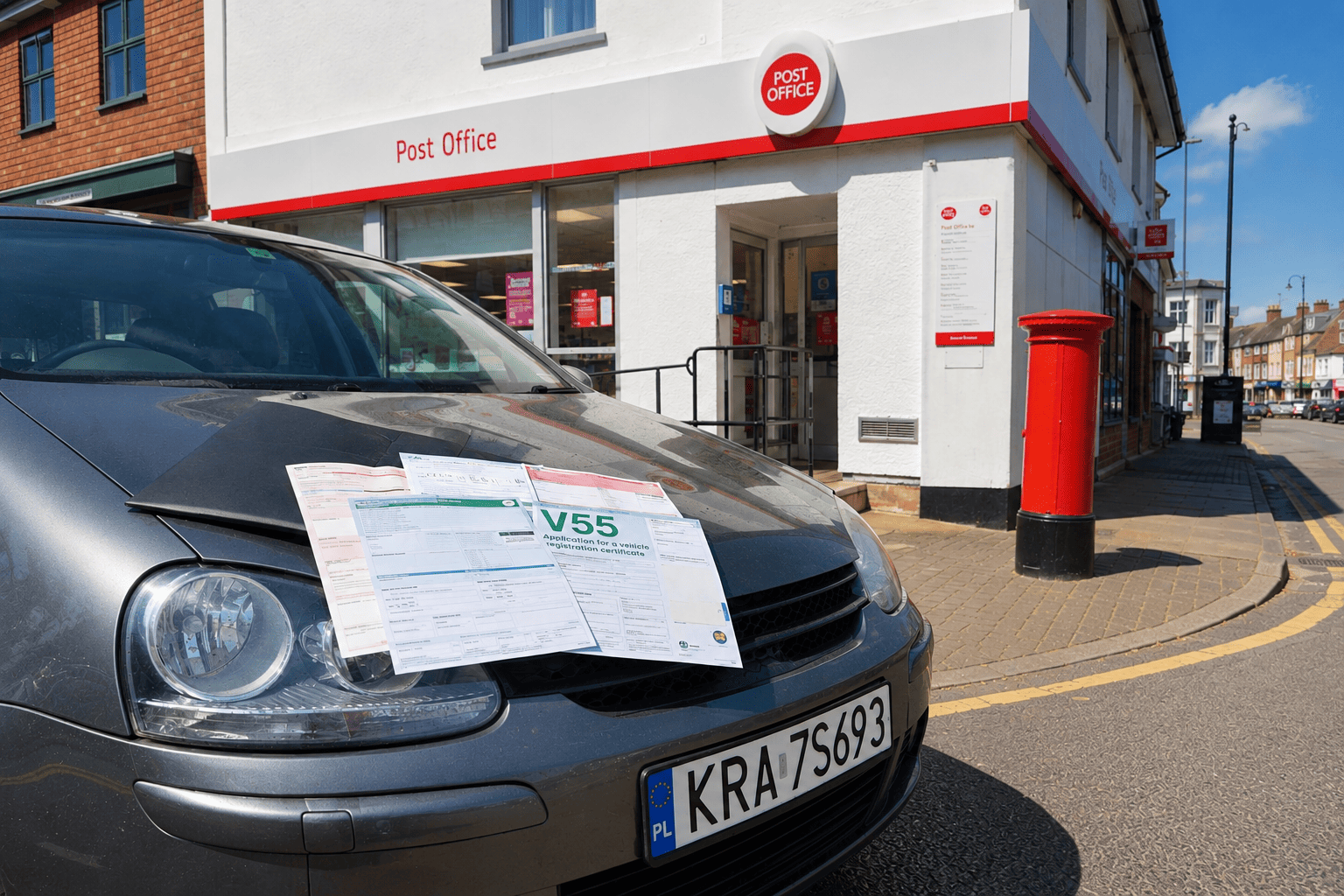
So your car has arrived. It is sitting at the port, cleared through customs, and you are ready to get it on the road. But before you can legally drive it, there is one final hurdle: you need to register an imported car in the UK with the DVLA.
It sounds simple. In practice, it catches a lot of people out.
At Ascope Shipping, we have been helping customers import and register vehicles for over 15 years. We have handled thousands of vehicles from Japan, the USA, Europe, Australia, Africa and beyond. For the full registration service and destination-by-destination detail, see our main DVLA registration page. This guide walks through the practical steps to register an imported car in the UK.
Why Registering Your Imported Car in the UK Matters
You cannot legally drive an imported car on public roads until it is registered with the DVLA. No registration means no UK number plates. No number plates means no valid insurance. And driving without insurance is a criminal offence.
Beyond legality, choosing to register an imported car in the UK properly gives your car a permanent UK identity, a V5C logbook in your name, a UK registration number, and the ability to tax it, insure it, and sell it without complications.
Skip this step, or get it wrong, and you could face fines, penalties from HMRC, and a vehicle you cannot legally use.
Step 1: Submit Your NOVA Declaration Within 14 Days
The very first thing to do when your imported car arrives is to tell HMRC.
You must submit a NOVA declaration, Notification of Vehicle Arrival, through the HMRC NOVA online portal. This must be done within 14 days of the vehicle arriving in the UK, without exception.
Once submitted and processed, HMRC issues a NOVA certificate. The DVLA will not register your vehicle without it. At Ascope Shipping, we submit the NOVA notification on your behalf as a standard part of our import service, so you never miss the deadline.
Step 2: Pay Import Duty and VAT
Before you can register an imported car in the UK, you must pay any import duty and VAT that HMRC calculates.
The standard rates are:
- Import duty: around 10% of the CIF value (cost, insurance, and freight) for most non-EU vehicles
- VAT: 20% on the CIF value plus any duty paid
- EU vehicles post-Brexit: zero import duty applies with valid proof of EU origin, but 20% VAT is still due
You can check the current rate for your vehicle on the gov.uk trade tariff. Your customs agent handles the declaration and payment process. Keep the receipts, since the DVLA may ask for proof of customs clearance when you apply to register a foreign car.
Step 3: Get Vehicle Approval (IVA or COC)
This is where many imports get delayed. Before you can register an imported car in the UK, your vehicle must prove it meets UK safety and environmental standards.
Two routes depend on your vehicle.
Route A: Certificate of Conformity (COC)
If your car was manufactured to European standards and you have a valid certificate of conformity from the manufacturer, you can use this to satisfy the DVLA’s vehicle approval requirements.
This is the quicker, easier route and common for cars imported from Germany, France, Spain, and other EU countries.
Route B: IVA Test (Individual Vehicle Approval)
If your car does not have a COC, which is typical for vehicles from Japan, the USA, and Australia or for grey imports, you will need to pass an IVA test instead.
The IVA test is carried out by the DVSA. It checks that your car meets UK road safety and emissions standards. The test fee is currently £199 for standard passenger cars.
Most non-EU vehicles need modifications before they can pass. Common changes include:
- Adjusting headlights to dip to the left (for UK driving)
- Converting the speedometer from km/h to mph
- Fitting a rear fog light in the correct position
- Adjusting seat belt anchorage points if needed
Vehicles over 10 years old can sometimes register via a standard MOT instead of the full IVA, but always confirm this with the DVLA or your import agent before assuming the exemption applies to your specific vehicle.
Step 4: Complete the V55/5 Form and Apply to the DVLA
Once you have your NOVA certificate and vehicle approval sorted, it is time to apply for registration.
The V55/5 form is the official application to register an imported car in the UK if it has been used before. For new (unregistered) vehicles, you will need the V55/4 form instead.
You cannot download and print these forms. They must be ordered from the DVLA and sent to you by post.
What to Send With Your V55/5 Form
The DVLA requires original documents only. Photocopies and faxed copies are not accepted. Send the following:
- Completed V55/5 form
- Your IVA test certificate or certificate of conformity
- The original foreign registration document (this is kept by the DVLA and not returned)
- Proof of identity
- Your NOVA declaration certificate from HMRC
- Proof of customs clearance and duty/VAT payment
- Form V627/3 if the vehicle has been structurally modified beyond the manufacturer’s specification
- Form V267 (declaration of newness) if registering a brand new vehicle
- Payment of the £55 DVLA registration fee
- Payment for the first year’s road tax (vehicle excise duty, based on CO2 emissions)
- Proof of UK insurance using the vehicle’s VIN number
Send everything to DVLA, Swansea, SA99 1BE by recorded post. For the full document checklist and what each one covers, see our car import documents UK guide.
Step 5: Wait for Your V5C and UK Number Plates
Once the DVLA receives and processes your application, they will issue a V5C logbook with your name as the registered keeper and a new UK registration number.
Processing typically takes four to six weeks from the date the DVLA receives your application. Delays are common if any documents are missing or require additional verification. If you have not received your V5C after six weeks, contact the DVLA directly.
Once your V5C arrives, you can have UK number plates made by any DVLA-registered supplier. At this point, your car is fully road legal.
How to Register an Imported Car in the UK: Country by Country
The core steps to register an imported car in the UK are the same for every vehicle. But the specific documents and approval route vary depending on where your car came from. For a full breakdown of each route, including African, classic, and EV imports, see our main DVLA registration page.
Japanese Import Car Registration
Japanese import registration almost always requires the IVA route. You will also need the Japanese De-registration Certificate (equivalent to the V5C) and the Shakken inspection certificate. Japanese cars are popular in the UK for their low mileage and excellent condition, but the IVA and modification requirements should not be underestimated.
USA Car Import Registration
USA car import registration follows the IVA route for most vehicles. US cars use mph speedometers already, which helps, but headlight adjustment and fog light fitting are almost always required. The US vehicle title document replaces the foreign registration certificate. See our USA to UK car import process guide for the complete journey.
EU Car Import Registration Post-Brexit
EU car import registration post-Brexit now requires full customs paperwork that was not needed before January 2021. For registration purposes, EU cars with a valid COC have an easier ride, but all the NOVA, customs, and DVLA steps still apply.
Can I Drive My Imported Car Before It Is Registered?
No. You cannot legally drive it on public roads until registration is complete and you have valid insurance.
The only exception is driving the vehicle to a pre-booked MOT or IVA test appointment, and even then, you need temporary insurance in place. See our guide on temporary car insurance before exporting your vehicle for how this works.
You can insure your car before receiving the V5C by using the vehicle’s VIN number. Specialist insurers handle this regularly, and Ascope Shipping can point you in the right direction.
What Happens If You Do Not Register Your Imported Car in the UK?
Failing to register an imported car in the UK after bringing it into the country carries serious consequences:
- HMRC can issue penalties for late or missing NOVA submissions
- You cannot tax or insure the vehicle legally
- Driving it on public roads is an offence
- The vehicle could be seized by UK Border Force or DVSA enforcement
- Reselling becomes extremely difficult without a UK V5C
Can Ascope Shipping Handle the Registration Process for You?
Yes, and for most people, letting a professional handle it is the smartest decision.
Ascope Shipping provides a complete service to register an imported car in the UK on your behalf, covering every stage of the process. We submit your NOVA declaration, arrange customs clearance, advise on IVA requirements and modifications, and guide you through the DVLA application from start to finish.
With years of experience and thousands of vehicles imported and registered across the UK, our team knows exactly what the DVLA and HMRC expect and how to get your vehicle on the road without unnecessary delays.
Whether you are importing a Japanese import, a USA car, a classic vehicle, or an electric car from Europe, we handle the paperwork while you focus on enjoying your new vehicle.
Register Your Imported Car the Right Way
Getting this right is not something you want to rush or guess at. One missing document or a late NOVA submission can cost you weeks and hundreds of pounds in delays.
Ascope Shipping has been the trusted choice for UK vehicle importers for over 15 years. We have successfully guided thousands of vehicles through the import and registration process, from Hull and Tilbury ports to driveways across the UK. Call us on 01482 228366, WhatsApp +447717769925, or email sales@ascopeshipping.co.uk to get your free quote today.