Choosing between air freight vs sea freight is one of the biggest decisions UK businesses and individuals face when shipping internationally. Get it right and you save money, hit your deadlines, and keep your customers happy. Get it wrong and you’re either overpaying or watching your delivery window slip away.
At Ascope Shipping, we’ve been helping UK businesses and individuals navigate international freight for over 15 years. We’ve seen every scenario imaginable, from urgent medical shipments that needed to fly to bulk containers of vehicles that made perfect sense by sea. For our full range of air freight services, visit our main air freight page. If you are shipping a vehicle specifically by air, see our guide on how air freight car shipping works.
Air Freight and Sea Freight Actual Difference
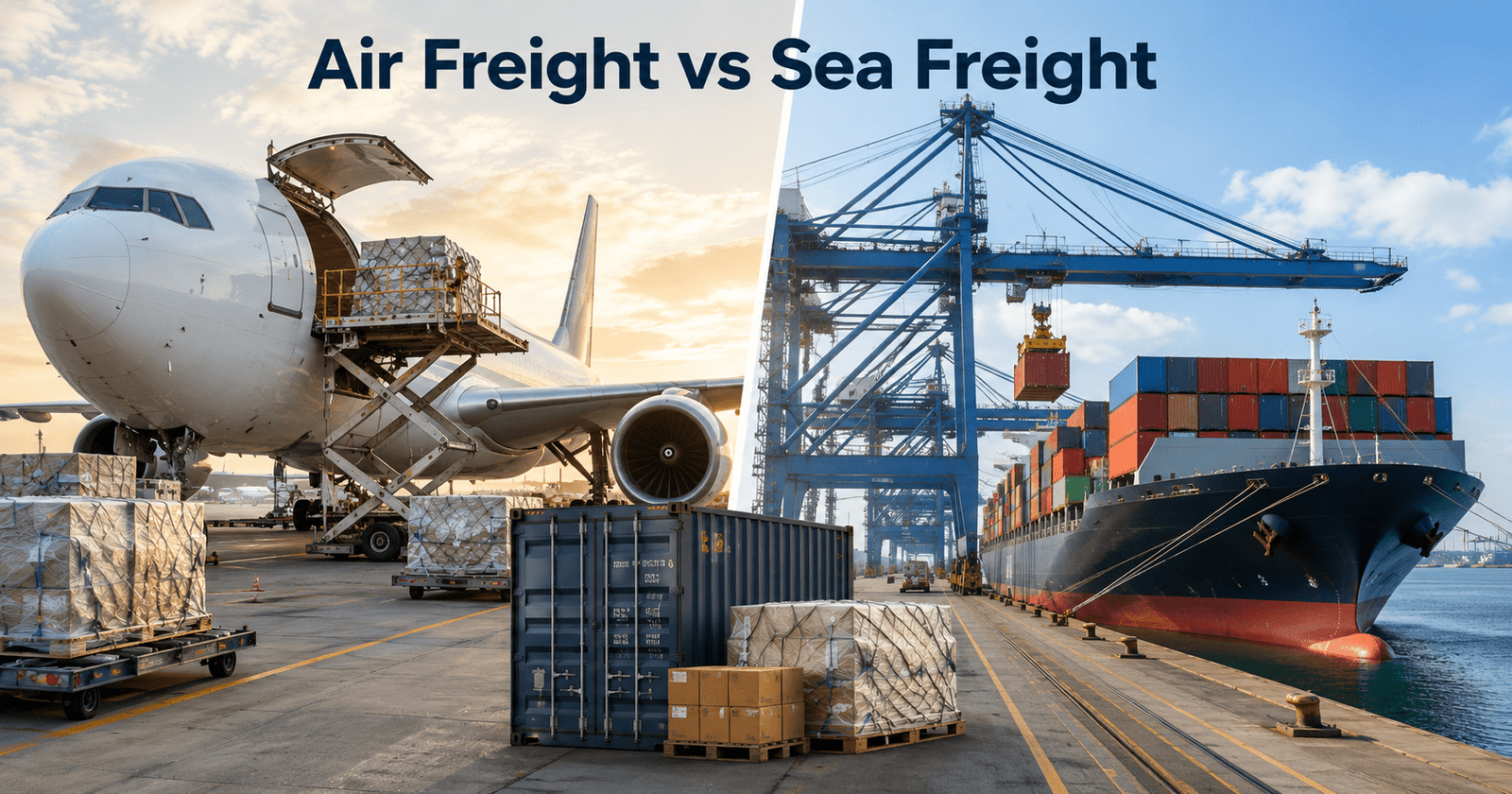
Air freight moves your goods via cargo aircraft fast and reliably but is premium-priced. Sea freight moves your cargo in shipping containers aboard vessels more slowly but is dramatically cheaper for larger or heavier shipments.
Both are legitimate international shipping methods. The right choice hinges on four key factors: cost, transit time, cargo type, and urgency.
Air Freight vs Sea Freight: UK to Worldwide Cost
Cost is usually the first thing people ask about, and rightly so. Here’s what you need to know.
How Air Freight and Sea Freight Costs Are Calculated
| Cost Factor | Air Freight | Sea Freight |
| Pricing Basis | Chargeable weight (actual or volumetric, whichever is higher) | Per container (FCL) or per CBM (LCL/groupage) |
| Standard Rate (UK origin) | £2.50 – £7.00 per kg | £40 – £80 per CBM (LCL) |
| 20ft FCL Container | Not applicable | £900 – £2,500 |
| 40ft FCL Container | Not applicable | £1,400–£3,500 |
| Volumetric Weight Formula | L × W × H (cm) ÷ 6,000 | N/A – charged by CBM |
| Fuel Surcharge (FSC) | Yes, typically adds 20–40% to base rate | Yes, BAF (Bunker Adjustment Factor) applies |
| UK Customs Duty Impact | Higher duty calculated on goods value + freight cost | Lower – cheaper freight reduces total duty bill |
| Terminal / Handling Fees | Airport handling: £50–£150 per shipment | Port THC: £80–£200 per container |
| Security / Screening Fee | Yes, mandatory, typically £0.10–£0.30 per kg | Not applicable |
| Insurance (Recommended) | 0.3 to 0.5% of cargo value | 0.3 to 0.5% of cargo value |
| Overall Cost vs Each Other | 4 to 6× more expensive than sea | 4 to 6× cheaper than air |
The Hidden Cost Nobody Talks About: UK Duty & VAT
This is where most people get caught out. When you import goods into the UK, customs duty is calculated on the cost of goods plus the shipping cost, so a higher air freight bill directly increases the duty and VAT you pay, even though the goods themselves cost exactly the same either way. You can review the UK government’s guidance on tax and duty on goods sent from abroad for the official rules. For a full breakdown of how UK duty and VAT are calculated on vehicles specifically, see our UK car import duty calculator guide.
For UK importers especially, choosing sea freight where possible is not just about saving on the freight itself, it is about keeping your total landed cost genuinely competitive.
Air Freight vs Sea Freight: Transit Times from the UK
| Destination | Air Freight Transit Time | Sea Freight Transit Time |
| Europe | 1 to 2 days | 3 to 7 days |
| USA / Canada | 3 to 5 days | 10 to 20 days |
| UAE / Middle East | 2 to 4 days | 18 to 25 days |
| India / Pakistan | 3 to 5 days | 20 to 30 days |
| West Africa | 3 to 6 days | 10 to 20 days |
| East Africa | 4 to 7 days | 18 to 28 days |
| Australia / New Zealand | 4 to 7 days | 25 to 40 days |
| China / Far East | 4 to 7 days | 28 to 38 days |
| Caribbean / Latin America | 5 to 8 days | 18 to 30 days |
| South Asia / Bangladesh | 4 to 6 days | 22 to 32 days |
Air freight is rarely delayed by weather or port congestion, which makes it highly predictable for time-sensitive shipping. Sea freight transit times, on the other hand, can be disrupted by port congestion, canal blockages such as the Red Sea shipping disruptions seen in recent years, or vessel scheduling changes. Always build buffer time into your planning, especially for routes with a history of congestion or seasonal delay.
When Should You Use Air Freight?
Air freight is the right choice when:
- Your goods are time-sensitive, such as seasonal stock, urgent orders, or event deadlines
- You are shipping high-value items (electronics, pharmaceuticals, luxury goods) where speed reduces risk
- Your shipment is relatively small or light, under 150 kg, where air can sometimes be surprisingly competitive
- Your cargo is perishable, such as fresh produce, cut flowers, or temperature-sensitive products
- You need maximum tracking and visibility throughout the journey
- Your destination has limited or unreliable sea routes
For small businesses shipping small batches of premium products, is air freight worth it? Often yes, especially when the cost of delay, such as lost sales, unhappy customers, or missed deadlines, outweighs the premium freight cost.
When Should You Use Sea Freight?
Sea freight is the smarter option when:
- You are shipping large volumes or heavy cargo like furniture, vehicles, machinery, or bulk goods
- Cost is the priority and timelines are flexible
- You are planning ahead, ordering stock weeks or months in advance
- You are shipping vehicles, containers, or oversized cargo, where air freight simply is not viable
- You want to reduce your carbon footprint: sea freight emits around 10 to 40g of CO2 per tonne/km versus air’s 500g+
At Ascope Shipping, a large proportion of our international cargo shipping services use sea freight, particularly for vehicle exports from the UK and container shipments to Africa, the Middle East, and Asia. Our clients save by planning and choosing the right method from the start. See our main container shipping and roll-on roll-off shipping pages for our full sea freight options.
What Goods Are Best for Air Freight?
Not everything should fly. Air freight works best for:
- Electronics, semiconductors, and tech equipment
- Pharmaceuticals and medical supplies
- High-value fashion and luxury items
- Fresh produce, perishables, cut flowers
- Urgent spare parts and manufacturing components
- Documents and small, high-value parcels
What goods are best for sea freight? Virtually everything else:
- Vehicles, cars, vans, trucks, and heavy machinery
- Furniture and household effects
- Clothing and textiles in bulk
- Construction materials
- Non-perishable food products
- Industrial equipment and plant machinery
Is Sea Freight More Reliable Than Air Freight?
Both methods have very high safety and delivery success rates. Air freight offers greater predictability, flights run on fixed schedules and aren’t subject to the kind of route disruptions that affect sea lanes. However, sea freight has improved enormously in terms of tracking and reliability, with real-time container visibility now standard across most major carriers.
If your definition of “reliable” means on-time delivery with minimal variance, air freight edges ahead. If it means safe arrival of goods in good condition, both are excellent.
Air Freight vs Sea Freight for UK Businesses: Our Expert Take
After years of freight forwarding and international cargo transport from the UK, the team at Ascope Shipping has the best way of thinking about this:
If time is money for your shipment, fly it. If weight is money, sell it.
Most businesses actually benefit from a mixed strategy: use sea freight for regular, planned stock replenishment, and keep air freight as your express option for urgent or high-value items. This combination gives you cost control without sacrificing flexibility when deadlines are critical.
If you are unsure which method suits your specific cargo, our team is happy to walk you through your options. We offer both air freight quotes and sea freight quotes and can help you calculate the true landed cost, including UK customs duties, so there are no nasty surprises.
FAQ — Air Freight vs Sea Freight
Air Freight vs Sea Freight: Which is cheaper
Sea freight is almost always cheaper, typically 4 to 6 times less expensive than air freight for the same weight. For heavy or bulk cargo from the UK, the cost difference is even more dramatic. Sea freight also results in lower UK customs duty and VAT because duty is calculated on goods value plus shipping cost, so a cheaper freight bill reduces your total import cost too.
How much faster is air freight than sea freight?
faster. Air freight from the UK typically arrives in 1–7 days, depending on the destination, while sea freight takes anywhere from 10 to 40 days. For destinations like Australia or the Far East, air freight can be 5–6 weeks quicker. The right choice depends on whether that time difference justifies the higher cost for your particular shipment.
What are the hidden costs of air freight shipping?
Beyond the base rate per kg, air freight typically includes fuel surcharges, security screening fees, airport handling charges, customs examination fees, and in some cases, dangerous goods surcharges. These add-ons can increase your bill by 20–40%. Always ask for an all-in quote that includes every charge before committing. At Ascope Shipping, we provide fully transparent pricing with no hidden extras.
How do I decide between air and sea freight for my business?
If you’re a small business with urgent stock needs, selling high-value items with tight delivery windows, or shipping goods where delay would cost you customers or contracts, air freight makes sense. For low-margin bulk goods or non-urgent stock replenishment, sea freight will protect your margins. The key is calculating your true cost, including the cost of delay, not just the freight bill.
What happens if my sea freight shipment is delayed?
Sea freight delays are usually caused by port congestion, bad weather, or route disruptions like canal closures. Your freight forwarder should notify you and provide a revised ETA. Cargo insurance can cover financial losses from significant delays, it is always worth having in place before your shipment departs.
Get a Free Freight Quote from Ascope Shipping
Whether you need a competitive air freight quote for an urgent shipment or a cost-effective sea freight quote for a planned container, Ascope Shipping is here to help. Based in Hull, UK, we ship cargo and vehicles to destinations worldwide with transparent pricing, expert customs guidance, and over 15 years of trusted experience. Get a free quick quote in under 60 seconds.