
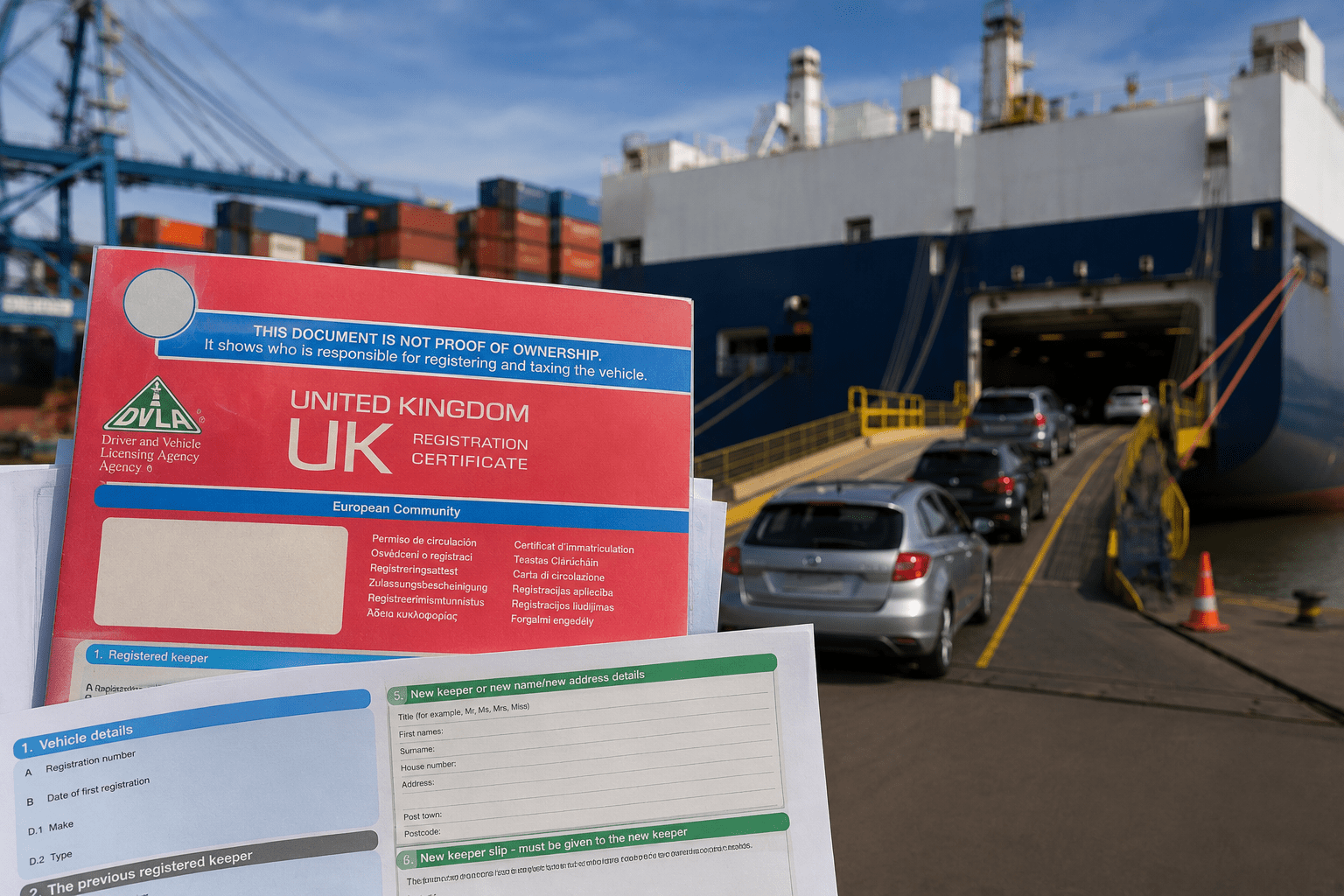
If you’re planning to ship your car overseas from the UK, there’s one document that sits at the very heart of the process: the V5C logbook. Without it, your vehicle could be held up at the port, customs clearance can be delayed, and in some cases, your shipment simply won’t proceed.
At Ascope Shipping, we’ve been helping customers ship cars internationally for over 15 years. One of the most common issues we see? People arrive at the port without the correct V5C paperwork or are unsure what to do with it when exporting permanently. This guide is here to fix that.
What Is a V5C Logbook?
The V5C logbook, officially called the Vehicle Registration Certificate, is a document issued by the DVLA (Driver and Vehicle Licensing Agency) to the registered keeper of every vehicle in the UK. It records who is currently responsible for the vehicle and contains all the key details about it.
It’s commonly called a “logbook” because, historically, vehicle records were kept in a physical book format. Today, it’s a single multi-section paper document, but the name has stuck firmly in everyday UK usage.
The V5C is not proof of ownership. This is one of the most misunderstood facts about it. It identifies the registered keeper, not necessarily the legal owner. If you purchased a vehicle on finance, for example, the finance company may be the legal owner even though your name is on the V5C.
What Information Does a V5C Contain?
Your V5C registration document is packed with information that matters for both day-to-day motoring and international car transport. Here’s what you’ll find inside:
- Vehicle registration number, make, model, and colour
- Engine size (cc), fuel type, and number of cylinders
- Vehicle Identification Number (VIN)
- Date of first UK registration and number of previous registered keepers
- Current registered keeper’s full name and address
- An 11-digit document reference number
- Whether the vehicle has been previously imported or exported
When you hand your car over for international shipping, your shipping agent will need to verify several of these details, particularly the VIN, registration number, and keeper information, to complete the export documentation correctly.
Old-Style vs New-Style V5C: What’s the Difference?
There are two versions of the V5C currently in circulation in the UK:
Old-style (blue-green, introduced 2004): Contains 12 sections. The new keeper supplement is found in Section 10.
New-style (red-pink, introduced 2012): Contains 11 sections. The new keeper slip is in Section 6. This is the version the DVLA now issues for all replacements.
Both versions are legally valid. However, if you still have the old-style document, the DVLA recommends updating to the new version, especially if you’re preparing to export your vehicle, as port authorities and overseas customs officials will be more familiar with the current format.
Is a V5C Proof of Ownership?
No, the V5C logbook is not proof of ownership. It proves vehicle registration and identifies the registered keeper, but legal ownership is established by a purchase receipt, invoice, or finance agreement. This distinction matters when selling, exporting, or insuring a vehicle. Always keep your purchase receipt alongside your V5C.
How to Get a V5C Logbook
Every newly registered vehicle in the UK is automatically issued a V5C by the DVLA. If you’ve bought a used car, the previous keeper should hand you the V5C (or the new keeper slip) at the point of sale.
If you didn’t receive one, or if yours has been lost or damaged, you’ll need to apply for a replacement.
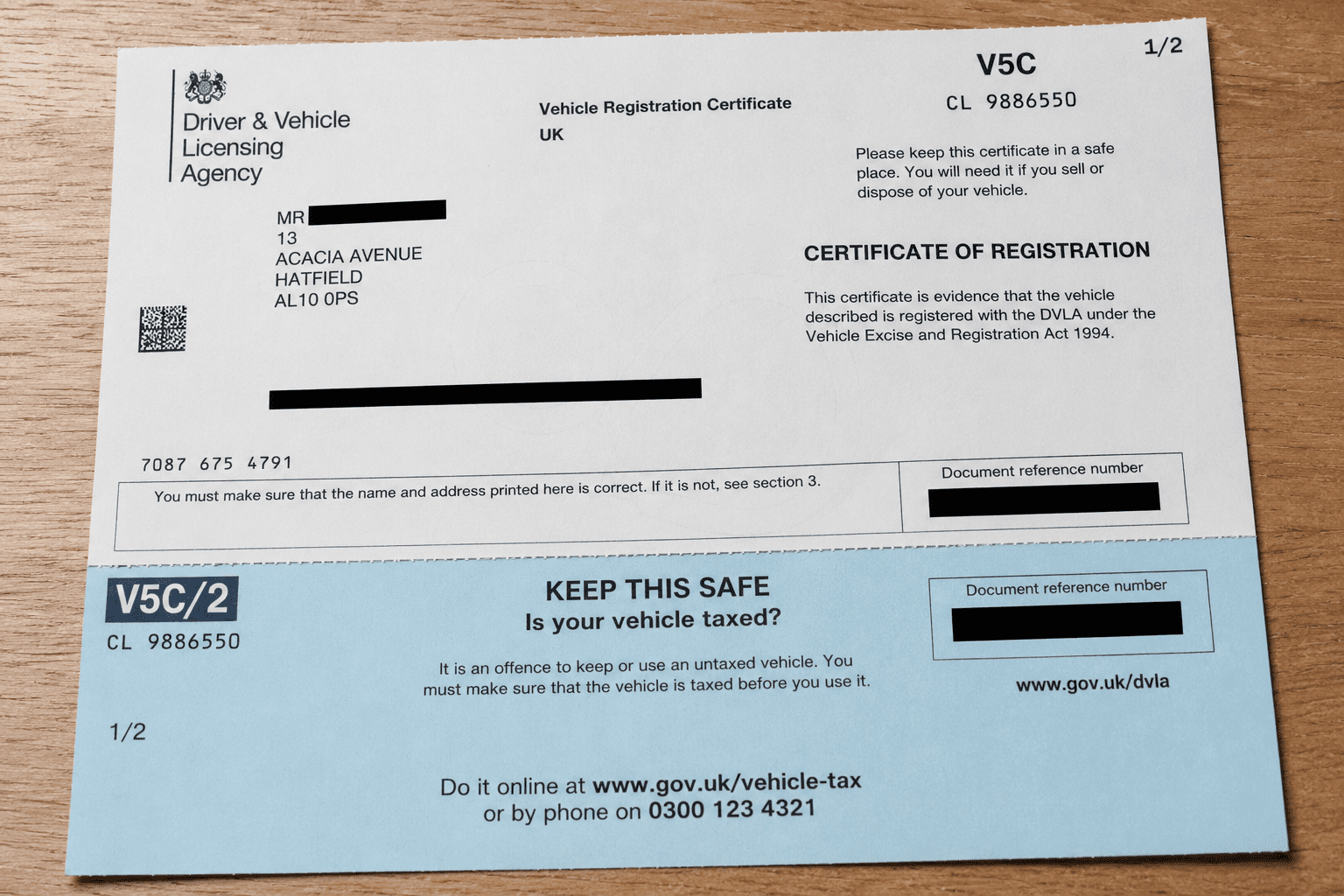
How to Replace a Lost V5C Logbook
Losing your V5C logbook is stressful, particularly if you need it urgently for a car sale or an upcoming shipment. Here’s exactly what to do.
Apply Online (Fastest Method)
Visit gov.uk/vehicle-log-book and use the DVLA’s online service. You’ll need:
- Your vehicle registration number
- Your Vehicle Identification Number (VIN) or chassis number
- The name and postcode registered to the vehicle
The replacement costs £25 (payable by debit or credit card). Your new V5C logbook will arrive within 5 to 7 working days. As of 2025, you can also tax your vehicle at the same time in a single online transaction.
Apply by Post (V62 Form)
Download or collect a V62 form from a post office or gov.uk. Complete all sections and post to:
DVLA, Vehicle Customer Services, Swansea, SA99 1BA
Allow up to 4 to 6 weeks for postal applications. If you haven’t received your replacement after 2 weeks, contact the DVLA directly.
Apply by Phone
Call the DVLA on 0300 790 6802. This is only available if your details remain unchanged from the missing or damaged V5C.
Ascope Shipping tip: If your V5C is lost and you need to ship your car urgently, apply online immediately, it’s the fastest route. Our team can advise on timing your export around the replacement window. Contact us here.
How Long Does DVLA Take to Send a V5C Logbook?
Online applications typically take 5 to 7 working days. Postal applications via the V62 form can take 4 to 6 weeks. If you haven’t received your replacement within 2 weeks of an online application, contact the DVLA. After 6 weeks with no V5C and no notification to the DVLA, a further £25 replacement fee applies.
Can You Ship a Car Without a V5C Logbook?
This is the question we get asked most often at Ascope Shipping and it’s complicated.
Most shipping companies and port authorities require the V5C as part of the export documentation. Without it, your vehicle may not be accepted for loading, and overseas customs may refuse clearance at the destination port.
What you can do if your V5C is missing:
- Apply for a replacement immediately via gov.uk: allow 5 to 7 working days
- Contact Ascope Shipping: In some circumstances, we can advise on alternative documentation to support your case while the replacement is in transit
- Do not attempt to export without notifying the DVLA: doing so creates legal complications at both the UK and destination ends.
If you’re shipping a car you’ve recently purchased and the V5C hasn’t arrived yet, ask the seller for the V5C/2 new keeper slip. This can serve as interim proof of registration while you wait.
What Part of the V5C Is Needed for Exporting a Car from the UK?
When you permanently export a vehicle from the UK, you need to complete Section 3 (Permanent Export) of the new-style V5C and then send the entire document to the DVLA at:
DVLA, Swansea, SA99 1BD
Do not send just Section 3, the whole logbook must go. The DVLA will then send you a V5C/2B export acknowledgement slip, which confirms the vehicle has been deregistered from the UK system. Keep this document safely, you may need it for overseas registration.
When the DVLA processes the export notification:
- The vehicle is deregistered from the UK database
- Any remaining full months of road tax are automatically refunded to the registered keeper
- Vehicle tax is cancelled from the date of export notification
Important: Do not take the V5C with you to your destination country. The V5C stays with the DVLA. You keep the V5C/2B acknowledgement.
V5C and International Car Shipping: What Ascope Shipping Needs
When you book an international car shipping service with Ascope Shipping, our documentation team will guide you through every step. Here’s what the V5C is used for during the export process:
- Port submission: The V5C registration details are submitted to the port authority as part of the export manifest
- Customs clearance (UK): HMRC and UK Border Force use V5C details to verify the vehicle identity during the export process
- Destination customs: Many countries, including the USA, Australia, and across the Middle East and Africa, require a copy of the V5C (or its equivalent) as part of the import documentation package
- Bill of Lading: Your V5C details feed directly into the Bill of Lading, the primary shipping document issued by the carrier
For RoRo shipping (Roll-on Roll-off), the V5C is part of the standard documentation checklist. For container car shipping, it’s equally essential, particularly for high-value or classic vehicles where customs valuation needs to be confirmed.
V5C Mistakes to Avoid When Exporting a Car
In 15 years of shipping vehicles from the UK, the Ascope Shipping team has seen the same V5C errors crop up time and again. Avoid these:
- Not notifying the DVLA before shipping: You are legally required to inform the DVLA of a permanent export before the vehicle leaves. Skipping this step means the car remains registered in the UK, creating tax liability, insurance complications, and potential legal issues.
- Sending only part of the V5C to the DVLA: You must send the entire V5C document when notifying of permanent export, not just Section 3. Many people tear out the section and post only that, which the DVLA cannot process.
- Trying to keep the V5C for overseas registration: The V5C stays in the UK (sent to the DVLA). You keep the V5C/2B acknowledgement slip for use abroad. Destination countries have their own registration processes, your UK V5C cannot substitute for a foreign registration document.
- Not checking the VIN matches: Before handing your vehicle to any shipping agent, verify that the VIN on the V5C exactly matches the VIN stamped on the vehicle (usually found on the dashboard or door frame). Mismatches cause significant delays at customs.
- Applying for a V5C replacement too late: If your V5C is missing, start the replacement process as soon as you know, don’t wait until the week before shipment. Allow at least 7 to 10 working days as a buffer.
What Documents Do I Need Alongside the V5C for International Car Shipping?
The V5C is essential, but it doesn’t travel alone. When shipping a car internationally from the UK with Ascope Shipping, you’ll typically need:
- V5C logbook
- Passport or valid photo ID
- Bill of Sale or purchase invoice
- Insurance certificate
- Import permit
- Power of Attorney
Our team at Ascope Shipping handles the full documentation process for you, from preparing the export paperwork to managing customs clearance at both ends. Get a free quote today.
What is the V5C/2 slip?
The V5C/2 is the green new keeper slip found in Section 6 of the new-style V5C. When you buy a car, the seller gives you this slip as temporary proof of registration until your full V5C arrives from the DVLA, typically within 4 weeks.
Can I view my V5C logbook online?
You cannot view the full V5C online, but you can apply for a replacement digitally via gov.uk/vehicle-log-book. The DVLA does not provide a digital version of the V5C, the physical document is still the official record.
Is it illegal not to have a V5C?
There’s no specific law requiring you to physically possess your V5C at all times. However, you are legally required to keep DVLA records up to date, and failing to notify them of changes, such as a sale or export, can result in fines of up to £1,000.
Ship Your Car with Confidence via Ascope Shipping
Whether you’re exporting a family car, a classic vehicle, or a fleet of commercial vehicles, the V5C logbook is the foundation of your export documentation and getting it right matters.
At Ascope Shipping, our team of international car shipping specialists has handled thousands of exports from UK ports, including Southampton, Tilbury, Liverpool, and Sheerness. We know exactly what DVLA requires, what port authorities expect, and how to make sure your V5C paperwork is in order before your vehicle reaches the dock. We offer RoRo shipping, container car shipping, and groupage services to destinations worldwide, including the USA, Australia, the Middle East, West Africa, and beyond.