Shipping your car overseas from the UK sounds simple until the paperwork starts. The truth is, most port delays, customs holds, and costly fines come down to one thing: missing or incorrect car export documents. Whether you’re sending a vehicle to Nigeria, Ghana, Australia, the USA, or anywhere else in the world, getting your documents required to ship a car right from day one is non-negotiable.
Ascope Shipping has been handling international car shipping from the UK for over 15 years. We’ve seen every paperwork mistake there is.
Why Car Shipping Documents Matter More Than You Think
Many people assume the documents are just admin. They’re not.
Your car export documents are legally binding. They prove ownership, authorize the movement of your vehicle across borders, satisfy HM Revenue and Customs (HMRC), and protect you if anything goes wrong in transit.
Get them wrong, and your vehicle can be held at the port of departure, refused entry at the destination, or hit with demurrage charges that stack up daily. Get them right, and your car moves smoothly from a UK port like Southampton, Tilbury, or Liverpool straight to your destination.
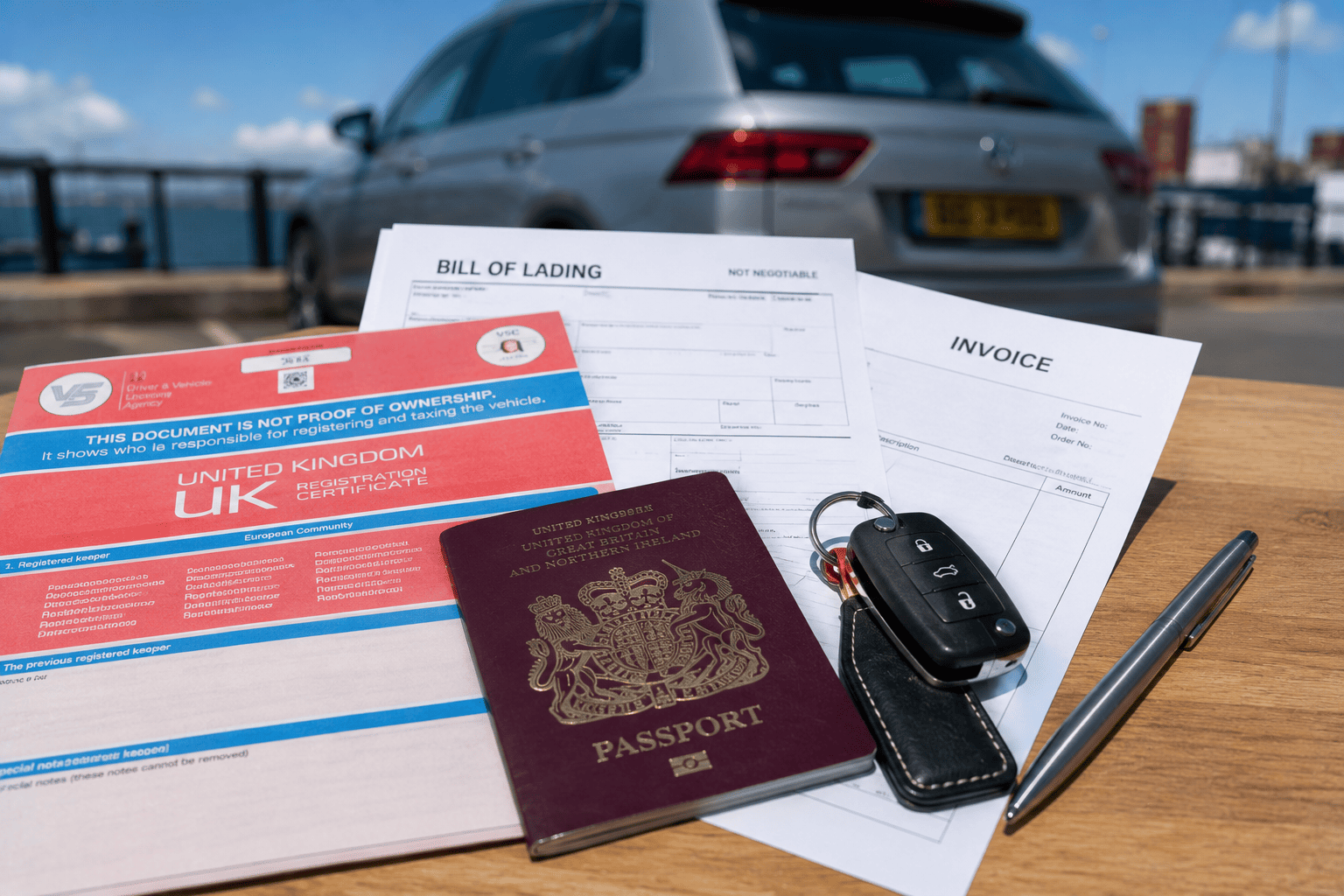
The Core Documents Required to Ship a Car from the UK
These are the documents every exporter needs, regardless of destination, shipping method, or vehicle type.
1. V5C Logbook (Vehicle Registration Certificate)
The V5C logbook is the starting point for every UK car export. It proves your vehicle is registered in the UK and links it to a registered keeper. Port authorities and customs officials will request it immediately.
Important: The V5C is proof of registration, not legal ownership. However, for vehicle export paperwork purposes, it is the accepted standard document to demonstrate your right to ship.
For permanent export: You must complete the permanent export section of the V5C (Section 4), detach it, and send it to the DVLA. Keep the rest of the logbook. You’ll need it to register the vehicle in the destination country.
If you’ve lost your V5C: Apply to the DVLA for a replacement using form V62 before you book shipment. Don’t leave this too late. Replacements can take up to 14 days.
2. Bill of Lading (BoL)
The Bill of Lading is arguably the most important document in the entire international car shipping process. It is a legally binding contract between you (the shipper), the carrier, and the recipient. It serves three purposes at once: a receipt for your vehicle, a contract of carriage, and a document of title.
What it includes:
- Shipper and consignee details
- Vehicle make, model, year, colour, and Vehicle Identification Number (VIN)
- Port of departure and destination port
- Shipping method (RoRo or container)
- Freight terms (prepaid or collect)
Always check your Bill of Lading carefully before departure. A single error, like a wrong VIN or a wrong consignee name, can cause a customs hold at the destination port.
Ascope Shipping prepares and verifies your Bill of Lading as part of our full-service shipping package, so nothing gets missed.
3. Purchase Invoice / Bill of Sale
If you’re exporting a vehicle you’ve bought or sold, customs authorities at the destination need to verify its declared value.
It must include:
- Seller’s full name and address
- Buyer’s full name and address
- Vehicle details (make, model, VIN, registration)
- Date of sale
- Sale price (must be accurate — undervaluing carries serious penalties)
- Signatures from both parties
This document is used to calculate import duties and taxes at the destination. An inaccurate invoice is one of the most common car shipping document mistakes to avoid.
4. Valid Passport or Government-Issued Photo ID
Most shipping agents and customs authorities will request proof of identity for the vehicle owner or exporter. A valid UK passport is standard. A government-issued photo ID is accepted where a passport isn’t available.
5. C88 Export Declaration (HMRC Customs)
The C88 export declaration is required by HM Revenue and Customs (HMRC) for vehicles leaving the UK permanently. This is your official notification to UK customs that the vehicle is being exported. It records the vehicle’s value, its HS (Harmonised System) code, the port of departure, and the destination country.
Post-Brexit, this process is now handled electronically through the HMRC Customs Declaration Service (CDS).
6. Marine Insurance Certificate
Marine insurance for car shipping isn’t always a legal requirement, but it is always a smart decision. It covers your vehicle against loss, damage, theft, or total loss during the ocean voyage. For standard cars, a standard marine policy is usually sufficient. For classic car export, always request an “agreed value” policy. This guarantees the full insured value is paid out, not the depreciated market value.
Some destination ports will ask to see your marine insurance certificate as part of their clearance process, so have it ready.
Additional Documents Depending on Shipping Method
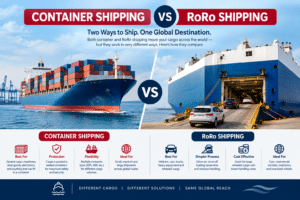
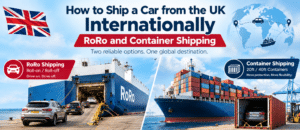
The documents required to ship a car can vary depending on whether you’re using RoRo (Roll-on/Roll-off) or container shipping.
RoRo Shipping Documents
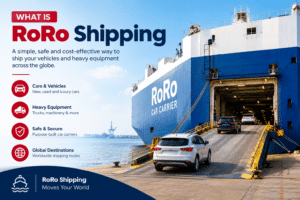
RoRo shipping is the most cost-effective method. Your car is driven directly onto the vessel. For RoRo, you’ll typically need:
- V5C logbook
- Valid MOT certificate (your vehicle must be roadworthy to drive onto the vessel)
- Purchase invoice
- Bill of Lading
- C88 export declaration
- Marine insurance certificate
- Photo ID
Container Car Shipping Documents
Container shipping is ideal for classic cars, high-value vehicles, or when you need extra protection. Additional documents may include:
- Packing list (describing how the vehicle is loaded and secured)
- Container number and seal number (added to the Bill of Lading)
- Vehicle inspection report (condition report before loading)
- Certificate of Conformity (for certain destination countries)
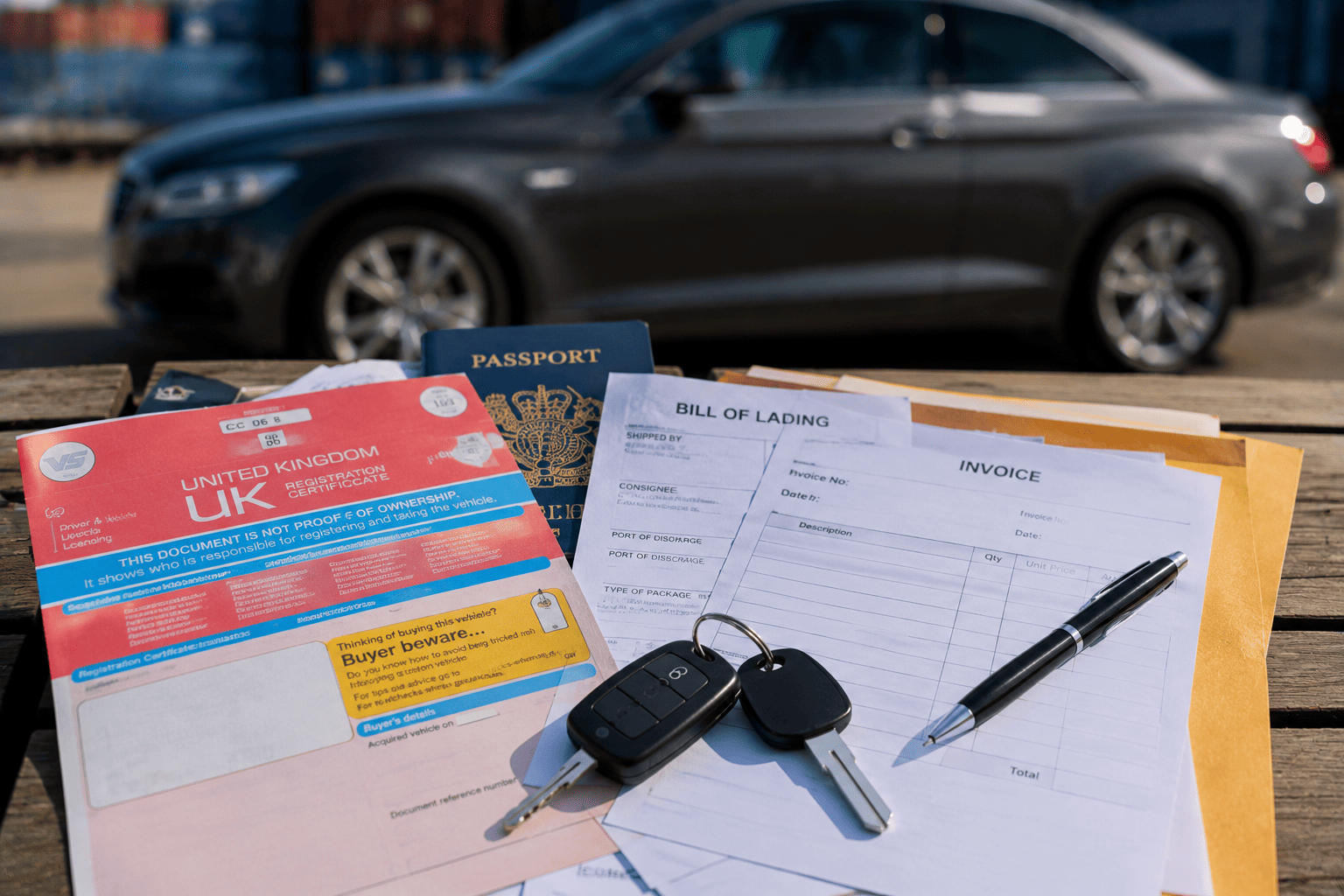
Destination-Specific Documents: Country-by-Country Overview
Different countries have their own import requirements. Here’s a quick reference for the most popular UK car export destinations.
| Destination | Key Extra Documents Required |
| Nigeria | BESC/CTN (cargo tracking note), pre-shipment inspection certificate, import permit |
| Ghana | CEPS destination inspection report, original BoL, purchase invoice |
| Kenya | IDF (Import Declaration Form), pre-shipment inspection, BoL |
| Australia | Biosecurity/fumigation certificate, Certificate of Conformity, AQIS clearance |
| USA | Original title (or V5C + BoL combination), EPA/DOT compliance docs, CBP entry forms |
| UAE / Dubai | Customs declaration, original BoL, purchase invoice, vehicle test certificate |
| Canada | Form 1 (Transport Canada), RIV inspection, BoL, title |
| New Zealand | Biosecurity clearance, MAF inspection, Certificate of Conformity |
| South Africa | Natis certificate or equivalent, BoL, purchase invoice |
| Jamaica | Import licence, BoL, purchase invoice, pre-shipment inspection |
Note: Requirements can change. Always confirm destination-specific rules with your car shipping agent before booking. At Ascope Shipping, we stay updated on the latest requirements for every route we serve.
Post-Brexit UK Car Export Rules: What’s Changed?
Since Brexit, exporting a car from the UK now involves additional customs steps that didn’t apply when the UK was part of the EU.
Key changes that affect your paperwork:
- All exports, including those to EU countries, now require a full C88 export declaration via HMRC’s Customs Declaration Service
- Proof of UK origin may be required for preferential tariff treatment under the UK-EU Trade and Cooperation Agreement
- Vehicles exported to EU countries may face import VAT and duties on arrival, depending on origin status
These changes don’t make shipping harder, but they do make accurate vehicle export paperwork even more important. Working with an experienced UK car export agent like Ascope Shipping means all of these compliance steps are handled for you, with zero risk of missing a post-Brexit requirement.
7 Car Shipping Document Mistakes That Cause Delays and Fines
Based on 15 years of experience at Ascope Shipping, here are the most common car shipping document mistakes to avoid:
- Sending the full V5C with the vehicle: You must retain the V5C and only send the permanent export section to the DVLA
- Undervaluing the vehicle on the purchase invoice: Customs authorities flag this immediately and it carries serious penalties
- Wrong VIN on the Bill of Lading: Even one digit wrong can halt clearance at the destination port
- Not notifying the DVLA before departure: You remain legally liable for the vehicle until the DVLA receives your notification
- Missing the fumigation certificate for Australia or New Zealand: Your vehicle will be held in quarantine without it
- No marine insurance in place: You have no recourse if the vehicle is damaged or lost at sea
- Leaving document preparation too late: Some documents, like the Certificate of Conformity, can take several weeks to obtain
Step-by-Step Car Shipping Documentation Checklist
Use this master checklist to prepare your UK car export documentation: no delays, no fines.
Stage 1. Before You Book (Provide to Your Shipping Agent)
- Copy of V5C logbook
- Copy of purchase invoice/bill of sale
- Valid passport or photo ID
- Confirmation of shipping destination and method (RoRo or container)
Stage 2. Before Your Vehicle Reaches the Port
- Original V5C (permanent export section completed and sent to DVLA)
- Original purchase invoice/bill of sale
- Valid MOT certificate (RoRo shipments)
- Marine insurance certificate
- C88 export declaration (submitted by agent via HMRC CDS)
- Vehicle inspection/condition report
- Destination-specific documents (fumigation certificate, pre-shipment inspection, etc.)
Stage 3. Documents for the Consignee at Destination
- Original Bill of Lading (or Sea Waybill copy)
- Commercial invoice
- Certificate of Conformity (if required)
- Import permit or customs declaration (destination country)
- Power of attorney (if customs broker is acting on recipient’s behalf)
How Ascope Shipping Handles Your Car Export Documents
International car shipping paperwork is complicated. Between DVLA notifications, HMRC export declarations, bills of lading, destination import permits, and marine insurance, there are a lot of moving parts.
That’s exactly why Ascope Shipping exists.
With over 15 years of experience in vehicle export service from the UK, our team handles every piece of car shipping documentation on your behalf. We know the exact requirements for every destination we serve, from Lagos to Los Angeles, from Dubai to Durban.
What we do for you:
- Prepare and verify your Bill of Lading
- Submit your C88 export declaration via HMRC
- Notify the DVLA of permanent export
- Advice on destination-specific document requirements
- Liaise with port agents and customs brokers worldwide
- Handle collection from your door and delivery to the destination port
You bring us the vehicle. We handle everything else. Get in touch today for a free car shipping quote and let’s get your vehicle moving with every document in perfect order.
FAQ About Shipping Documents
Is a V5C logbook required to ship a car from the UK?
Yes. The V5C logbook is essential for all UK car exports. For permanent export, you complete Section 4 (the permanent export section), send it to the DVLA, and retain the rest. Without it, your shipment cannot proceed at the UK port.
What is the V5C permanent export section and how do I use it?
The permanent export section is Section 4 of your V5C logbook. Detach it, fill in your details and the destination country, then post it to the DVLA. Keep the remainder of your V5C. You’ll need it to register the car abroad. Your shipping agent can handle this process for you.
Do I need an MOT certificate to ship my car overseas from the UK?
For RoRo shipping, yes, your vehicle must be roadworthy to drive onto the vessel, so a valid MOT is required. For container shipping, an MOT is not always mandatory, but it is recommended as evidence of the vehicle’s condition at point of loading.
What documents are different for RoRo shipping versus container shipping?
RoRo requires a valid MOT as your car is driven on board. Container shipping requires a packing list, container seal number, and often a detailed vehicle inspection report. Both methods require a V5C, bill of lading, purchase invoice, C88 export declaration, and marine insurance.
What happens if my car documents are missing or wrong at a UK port?
Your vehicle will be held at the port and cannot be loaded. Each day it sits there, it accrues demurrage (storage) charges. In serious cases, shipment may be refused entirely. This is why Ascope Shipping checks every document before your vehicle reaches the port to make sure this never happens.
How long does UK car export paperwork usually take to prepare?
For most standard shipments, documents can be prepared within 3–5 working days. However, some destination-specific documents, such as a Certificate of Conformity or a pre-shipment inspection certificate, can take 2 to 4 weeks. Always start the paperwork process as soon as you decide to ship.
Avoid Costly Mistakes with Ascope Shipping Handling Every Document
The documents required to ship a car from the UK aren’t just a box-ticking exercise. They’re the backbone of a smooth, legal, stress-free export. Every document tells a story to customs, to carriers, and to destination authorities about who owns the vehicle, what it’s worth, and why it’s being moved.
At Ascope Shipping, we’ve shipped thousands of vehicles from UK ports, including Southampton, Tilbury, Liverpool, and Hull to destinations across Africa, the Americas, Asia, the Caribbean, and beyond. Our team knows exactly what paperwork for shipping a car abroad from the UK looks like for every route, every method and every vehicle type. Get your free quote from Ascope Shipping today and let our experienced team handle every single document on your behalf.nn
🚚 Related Services from Ascope Shipping
Need a free quote? Contact Ascope Shipping today — UK’s trusted vehicle shipping specialists with 686 Trustpilot reviews.