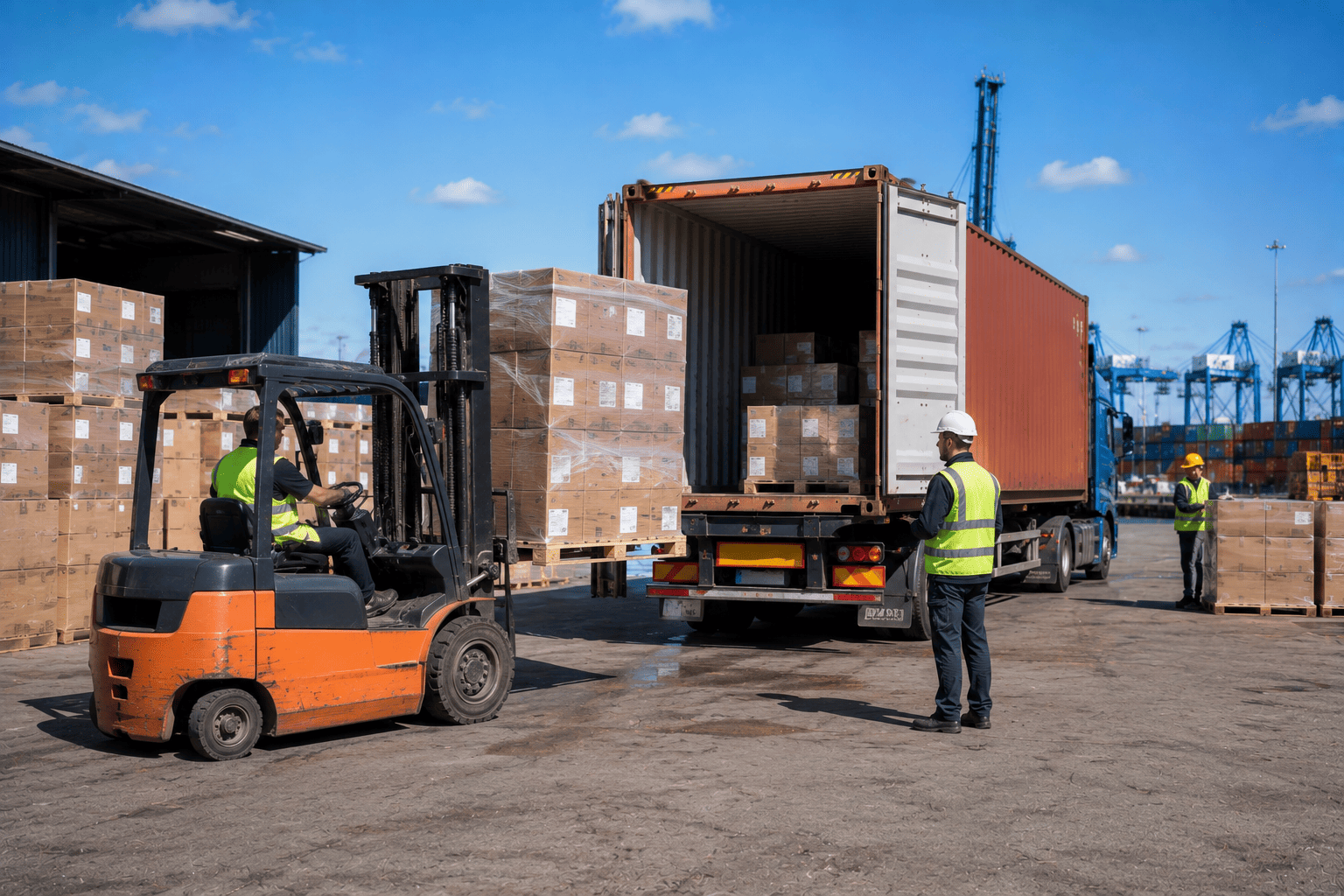
Thinking about selling your products overseas? Or maybe you’ve already got an international buyer lined up, but you’re not sure how the process actually works? Learning how to export goods from the UK is a genuine growth opportunity for businesses of every size, from sole traders sending their first overseas order to established companies expanding into new markets. It just takes the right preparation, the right paperwork, and the right shipping partner.
At Ascope Shipping, we’ve helped UK businesses export goods from the UK to Africa, the Americas, the Middle East, the Caribbean, Australia, and beyond for over 15 years. This isn’t theory, it’s the real process, explained by people who handle it every day.
The UK Export Process at a Glance
Getting your goods to an overseas buyer comes down to six clear stages. Below is the business-level overview; for the deep customs detail (EORI, HS codes, CDS declarations and documents), follow our companion guide to UK customs clearance for exporters, which covers that side step by step.
- Register for an EORI number: your unique GB-prefixed HMRC identifier, free to obtain and essential before any goods move
- Check export regulations: confirm your goods aren’t controlled, restricted, or sanctioned for your destination
- Classify with HS codes: the 10-digit commodity code that sets duty rates and documentation at the destination
- Prepare your export documents: commercial invoice, packing list, bill of lading, and certificate of origin where needed
- Choose your shipping method: sea (FCL or LCL groupage) or air, based on volume, budget, and urgency
- Submit your declaration and ship: filed via HMRC’s CDS, with your agent handling it on your behalf
The rest of this guide focuses on the commercial decisions that actually grow your export business, regulations, VAT, shipping choice, costs, markets, and Incoterms, rather than repeating the customs mechanics covered in the guide linked above.
Step 1: Check Your UK Export Regulations
Not everything can leave the UK without checks. Before booking freight, confirm whether your goods fall under any export controls:
Export licence requirements: controlled goods, including weapons, dual-use items, and certain chemicals, need an export licence first.
Restricted goods: animals, plants, medicines, food, and antiques all carry specific rules. Our guide to prohibited and restricted items breaks these down in full.
Sanctions: certain countries face UK trade restrictions. Always check the current UK sanctions list on GOV.UK before booking.
Step 2: Understand UK Export VAT Rules
UK export VAT is one of the most misunderstood areas for first-time exporters, and it’s where this guide adds the most value beyond the customs paperwork. Here’s the clear version.
When goods leave the UK, they are zero-rated for UK VAT, so you do not charge VAT to your overseas buyer. However, you must keep proof the goods actually left the UK, record the export on your VAT return (even at 0%), and retain all export documentation for at least 6 years.
Exporting to Europe? Your goods arrive VAT-free at the UK border, but your EU buyer may face import VAT and duties on arrival, depending on local rules and the Incoterms agreed in your contract. Exporting to the USA works on the same principle: zero-rated for UK VAT, with your American buyer handling US import taxes on their side.
Step 3: Choose the Right Shipping Method
This decision shapes your costs, transit times, and risk. Here are your real options for shipping goods overseas from the UK.
Sea freight is the most cost-effective method for larger shipments and the backbone of most international cargo shipping from the UK. It comes in two forms:
- FCL (Full Container Load): your goods fill an entire 20ft or 40ft container, best for large volumes, with faster transit and less handling.
- LCL (Less than Container Load): also called groupage shipping, your goods share space and you pay per cubic metre, best for smaller shipments.
Air freight is the fastest option, 3 to 14 days to most destinations, best for small, high-value, or urgent goods. Costs run much higher than sea, so it rarely suits bulky cargo. Learn more about air freight.
Not sure which UK port suits your route? Our guide to the best UK ports for international cargo shipping helps you pick the most cost-effective departure point.
Step 4: Get Your Export Documents Ready
Good paperwork is the foundation of a smooth export. Most shipments need a commercial invoice (with Incoterms, values, and HS codes), a matching packing list, a bill of lading, and a certificate of origin where you’re claiming preferential duty rates. Controlled goods also need an export licence, and a proforma invoice is often requested by buyers before payment.
A note on the bill of lading: it confirms ownership, route, and cargo details. If you haven’t been paid yet, hold the bill of lading until funds clear, it is your security. Cargo insurance (marine all-risk, typically 1.5% to 3% of value) is not a legal requirement but is strongly recommended.
Choosing the Right Incoterms
Incoterms are the international rules that define exactly who is responsible for freight, insurance, and customs at each stage of the journey, and for an exporter, they directly affect your cost, risk, and competitiveness. Getting them right is a commercial decision, not just a paperwork one.
- EXW (Ex Works): the buyer takes on almost everything from your door, lowest responsibility for you, but least attractive to many buyers
- FOB (Free on Board): you cover costs until the goods are loaded at the UK port, a common, balanced choice for sea freight
- CIF (Cost, Insurance, Freight): you cover freight and insurance to the destination port, more attractive to buyers, more cost to you
- DDP (Delivered Duty Paid): you handle everything including destination duties, the most buyer-friendly but highest-risk option for you
Choosing the wrong Incoterm can quietly hand you unexpected costs or liability, so agree them clearly in every contract before you ship.
UK Export Shipping Costs
One of the first questions any UK business asks is what international shipping actually costs. The ranges below are approximate, indicative figures; contact us for an exact quote.
| Shipping Method | Approximate Cost Range |
|---|---|
| LCL / Groupage (sea freight) | £80 to £200 per CBM |
| 20ft FCL container | £800 to £3,500 (by destination) |
| 40ft FCL container | £1,200 to £6,000 (by destination) |
| Air freight | £3 to £8 per kg (plus volumetric charges) |
| Cargo insurance | 1.5% to 3% of declared value |
Costs vary by destination, volume, season, and commodity. For most small businesses, the cheapest way to export goods from the UK is LCL groupage sea freight, where you pay only for the space you use.

Where Can You Export Goods from the UK?
Ascope Shipping supports commercial exports from the UK to destinations worldwide. Here’s a quick guide to key markets.
Export to Africa
West Africa (Nigeria, Ghana), East Africa (Kenya, Zimbabwe), and Southern Africa (South Africa, Namibia) are strong markets for UK exporters, and one of our deepest specialisms. Regular LCL groupage and FCL services run to these routes. Documentation requirements are detailed, local import permits, destination inspections, and specific certificate-of-origin formats, and our team knows exactly what each African port needs.
Export to the USA and Canada
Major markets for UK exporters. Shipping to the USA needs a detailed commercial invoice, packing list, and US customs entry documentation. Sea transit takes 4 to 6 weeks; air freight delivers in 5 to 10 days.
Export to the UAE and Gulf
Strong demand from Dubai, Abu Dhabi, Saudi Arabia, and Qatar. Sea freight runs 3 to 5 weeks, typically via Southampton or Tilbury, with well-established, manageable import documentation.
Export to Australia and New Zealand
Sea freight takes 5 to 8 weeks. Biosecurity rules are strict, wooden packaging, certain foods, and plant-based materials need declaration and may require treatment, so plan extra lead time.
Export to the Caribbean
A key route for us, with regular groupage services to Jamaica, Trinidad, Barbados, and the wider Caribbean. Transit runs 4 to 7 weeks.
Do You Need a Freight Forwarder to Export?
Technically, no, you can file your own declaration through CDS. But in practice, most UK businesses use a freight forwarder or export cargo company, and for good reason. An experienced forwarder handles HS code classification, the CDS declaration, customs clearance at the UK port, booking cargo space, coordinating collection and delivery, and advising on Incoterms, the details that cause costly delays when they go wrong.
Common UK Export Mistakes to Avoid
- Wrong HS codes: every commodity-code error is a compliance risk at the destination, verify codes independently
- Mismatched documents: invoice, packing list, and bill of lading must align precisely, any mismatch triggers inspection
- Missing proof of export: essential for your UK VAT records, without it, HMRC can disallow your zero-rating
- Poor Incoterms choices: the wrong Incoterm can hand unexpected cost or liability to you or your buyer
- No cargo insurance: goods do get damaged or lost in transit, insurance is one of the best-value protections an exporter has
Why UK Exporters Choose Ascope Shipping
- 15 years of specialist experience: across every sector, destination, and cargo type, from cars and containers to groupage and commercial freight
- Africa and Caribbean specialists: with the agent networks and documentation expertise for routes most forwarders do not cover well
- One-stop service: export declaration, customs clearance, cargo booking, and port handling under one roof, which means fewer errors and fewer hand-offs
- Transparent pricing: clear, complete export quotes with no surprise fees at the port
- Trusted by UK businesses since 2010: backed by a 4.6-star Trustpilot rating that reflects what exporters already know
Frequently Asked Questions
How do I start exporting goods from the UK?
Get an EORI number, classify your goods with the correct HS code, prepare your documents (commercial invoice, packing list, bill of lading), submit an export declaration via HMRC’s CDS, and arrange freight with an export cargo company or freight forwarder. For the full customs steps, see our UK customs clearance for exporters guide; your agent handles most of this for you.
Do I charge VAT when I export goods from the UK?
No. Exports from the UK are zero-rated for VAT, so you don’t charge UK VAT to overseas buyers. You must keep proof of export for HMRC and report the sale on your VAT return at 0%. Your overseas buyer may face import VAT and duties in their own country.
What is the cheapest way to export goods overseas from the UK?
LCL groupage sea freight is the most affordable method for smaller volumes, as you share container space and pay per cubic metre. For larger shipments, FCL container shipping offers better value. Sea freight is always far cheaper than air freight for commercial cargo.
Which Incoterm should I use as a UK exporter?
It depends on how much responsibility you want to take. FOB (you cover costs to the UK port) is a common, balanced choice for sea freight. CIF and DDP are more buyer-friendly but cost you more, while EXW shifts almost everything to the buyer. Agree Incoterms clearly in every contract.
Do I need a freight forwarder to export from the UK?
You don’t legally need one, but using an experienced UK export agent significantly reduces risk. They handle export declarations, HS codes, customs clearance, shipping bookings, and documentation, preventing costly delays, HMRC penalties, and compliance errors on your first or fiftieth shipment.
Which markets are best for UK exporters?
It depends on your product, but strong, well-served routes from the UK include West and Southern Africa, the USA and Canada, the UAE and wider Gulf, Australia and New Zealand, and the Caribbean. Each has its own documentation and duty rules, which an experienced forwarder can guide you through.
Start Exporting from the UK with Confidence
Exporting opens up markets worth billions, from the 440 million consumers across Europe to the fast-growing economies of Africa and the Gulf. With the right partner, the paperwork, customs, and logistics become manageable parts of your business, not barriers to it.
Ascope Shipping has helped UK businesses of every size export goods from the UK for over 15 years. To plan your first or next shipment, explore our cargo shipping service or read our companion UK customs clearance for exporters guide, or speak to our team on 01482 228366 for a fully itemised quote.