Exporting goods from the UK should be simple, but it isn’t for many businesses. The customs side, the declarations, the codes, the documents to get right, is where the clock starts ticking, not because the rules are impossible, but because nobody explains them clearly.
At Ascope Shipping, we have handled UK customs clearance for exporters across every sector for over 15 years. From vehicles and household goods to commercial cargo heading to Africa, the Caribbean, and beyond, we have seen every customs situation imaginable.
What UK Customs Clearance Actually Means
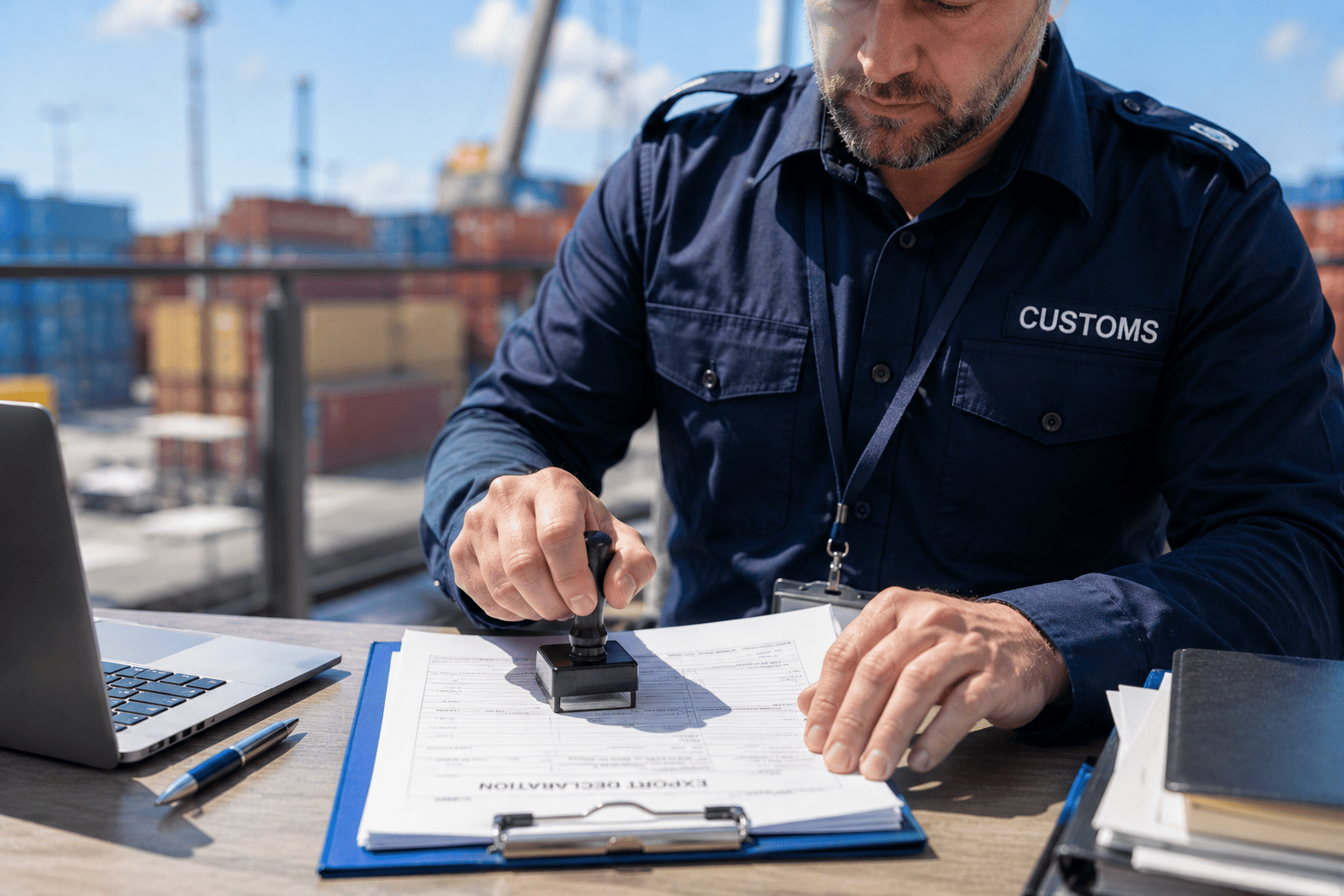
UK customs clearance for exporters is the official process of declaring goods to HMRC before they leave the country. Every shipment departing the UK, whether it is heading to the USA, Africa, or anywhere else, must be declared and cleared before it can legally cross the border.
It is not just a formality. Proper customs clearance serves several important purposes:
- It records what is leaving the country (HMRC trade statistics)
- It enables you to zero-rate VAT on exported goods, which means you need proof of export
- It ensures compliance with UK export controls and international regulations
- It flags any goods that require special licences or permits
Since Brexit, this applies to all international shipments from the UK, including exports to EU countries, which previously required no customs formalities at all. For any UK business shipping overseas, getting customs clearance right is the difference between a smooth departure and goods stuck at the port.
The UK Customs Clearance for Exporters Process
Understanding the customs process need not feel intimidating. Here are the five key steps.
Step 1: Get Your EORI Number
Before you can export anything, you need an EORI number (Economic Operators Registration and Identification). This is your unique identifier with HMRC. Without it, no export declaration can be submitted and your goods will not move.
Your EORI number starts with GB and is followed by 12 digits. If you are VAT-registered, you can often get one through HMRC’s website. Most businesses receive it within a few hours.
Step 2: Classify Your Goods with HS Codes
Every product exported from the UK must have an HS code (Harmonised System commodity code). This is a 10-digit code from the UK Trade Tariff that identifies exactly what your goods are. HS codes are not optional. They determine duty rates at the destination, flag any licensing requirements, and are a mandatory field on every export declaration. Getting the wrong code is one of the most common and costly mistakes exporters make. HMRC lists every commodity code through the UK Trade Tariff, and if you are unsure, our customs clearance agent can help.
Step 3: Prepare Your Export Documents
Accurate paperwork keeps your shipment moving. Most exports need a commercial invoice (with HS codes, values, and Incoterms), a packing list, a Bill of Lading or air waybill, and a certificate of origin where you are claiming preferential duty rates. Controlled goods also need an export licence, and temporary exports need an ATA Carnet.
Step 4: Submit Your Export Declaration via CDS
The export declaration is submitted through HMRC’s Customs Declaration Service (CDS), the digital platform that replaced the old CHIEF system. CDS now handles all UK export declarations.
Once submitted and accepted, you receive a Movement Reference Number (MRN). This is your proof that the declaration has been lodged. Your transporter needs this to get your goods across the border.
Step 5: Goods Released, Departure Confirmed
The final step is physical movement. Your cargo goes to the port named in the declaration, and your transporter presents the MRN at the border. Provided everything is in order, your goods are released for export.
UK customs clearance for exporters is typically completed within 1 to 3 working days when the paperwork is complete and correct. Pre-lodging your declaration before the goods arrive at port speeds things up further.
Export Customs Documents Checklist
Getting UK customs clearance for exporters right starts with your paperwork. Use this checklist before every shipment to make sure nothing is missing:
- EORI number (GB format)
- Commercial invoice (with HS codes, values, Incoterms)
- Packing list (matching invoice exactly)
- Bill of Lading or air waybill
- Certificate of origin
- Export licence (if required for your goods)
- ATA Carnet (for temporary exports only)
- CDS export declaration submitted and MRN obtained
- Proof of export retained for VAT records (keep for 6 years)
What Is the CDS System?
The CDS (Customs Declaration Service) is HMRC’s digital platform for processing all UK export and import declarations. It replaced the old CHIEF system and is now mandatory for all UK exporters.
Think of it as HMRC’s central database for international trade. Every declaration you submit, or your customs clearance agent submits on your behalf, goes through CDS.
You access CDS through your Government Gateway account, with your EORI number linked to it. Most businesses use a customs clearance broker or freight forwarder to file through CDS-compatible software, rather than doing it directly.
The legal responsibility for declaration accuracy stays with you, even when a broker files on your behalf. That is why working with an experienced, trusted UK cargo shipping company that understands compliance matters.
Post-Brexit UK Export Customs Rules
Brexit changed everything for UK exporters, particularly those trading with the EU. Here is what is critical to know.
Exporting to the EU After Brexit
Since 1 January 2021, the EU has been treated as a third country for UK customs purposes. That means every shipment to France, Germany, Spain, or any other EU member state now requires full UK customs clearance for exporters, just like shipping to the USA or Australia.
The rules remain largely stable since the initial post-Brexit transition, but HMRC scrutiny continues to tighten, so accurate declarations matter more than ever for UK exporters trading with Europe.
Rules of Origin
Rules of origin determine whether your goods qualify for preferential (reduced) duty rates under the UK-EU Trade and Cooperation Agreement (TCA).
To benefit from zero or reduced EU import duties, your goods must genuinely originate in the UK, meaning they were manufactured or substantially transformed here. You prove this through an origin declaration on your invoice or a certificate of origin from an approved body such as your local chamber of commerce.
Getting this wrong triggers backdated duty charges, interest, and penalties. It is one of the most under-appreciated risks for UK exporters trading with the EU.
UK Customs Clearance Costs
One of the most common questions we hear at Ascope Shipping is, “What does UK customs clearance actually cost?”
The figures below are approximate 2026 agent service fees and vary by declaration complexity and provider. Contact us for an exact quote.
| Service | Typical Cost |
|---|---|
| Standard export declaration (agent fee) | £45 to £120 per declaration |
| Complex declaration (multiple commodity lines) | £100 to £250 |
| Urgent / same-day customs clearance | £150 to £350+ |
| Certificate of origin (Chamber of Commerce) | £25 to £60 |
| ATA Carnet (depending on goods value) | £250 to £500+ |
These are agent service fees, separate from any duties or taxes payable at the destination country. The cost of getting it wrong, however, is far higher. HMRC civil penalties for customs contraventions escalate for repeated offences, typically from £500 up to £2,500, and must be issued within a three-year time limit. HMRC can also recover underpaid duties going back three years.
Common UK Export Customs Mistakes to Avoid
After 15 years of handling UK customs clearance, Ascope Shipping has seen the same mistakes trip up exporters repeatedly. Here are the most costly ones:
- Wrong HS codes: Copying codes from your supplier’s invoice without checking them yourself is risky. You are legally responsible for the accuracy of your declaration, not your supplier.
- Incomplete commercial invoices: Missing Incoterms, vague goods descriptions, or wrong values all trigger holds. Every field must match your packing list and transport document exactly.
- Missing EORI number: Goods cannot move without it. Apply before you book your first shipment.
- Forgetting proof of export: You need this to zero-rate VAT on your exported goods. Without it, HMRC can challenge your VAT return.
- Late declarations: Submitting your declaration after goods have departed can result in penalties and compliance flags that affect future shipments.
- No rules of origin documentation: If you are exporting to the EU and claiming preferential rates under the TCA, you need the evidence to back it up. An assumption is not proof.
Customs Broker vs Freight Forwarder
This causes genuine confusion among exporters. Here is the short version.
A customs clearance broker specialises specifically in preparing and submitting customs declarations. Their expertise is compliance, making sure your declaration is accurate, complete, and filed on time. A freight forwarder organises the physical movement of your goods, booking cargo space, arranging collection, and managing transport logistics. Many freight forwarders also offer customs clearance, but customs is often a secondary function.
Ascope Shipping does both. With 15 years of specialist experience in international cargo shipping and UK customs clearance for exporters, we handle your documentation and logistics under one roof, which means fewer hand-offs, fewer errors, and a faster, smoother process from collection to delivery.
UK Customs Clearance for Vehicle Exports
Shipping a car abroad needs customs clearance too, with its own specific documents (a V5C logbook, sale invoice, and accurate make, model, and VIN details). Because this is a topic in its own right, we cover it fully on our car shipping document and international car shipping pages. Whether you are exporting a single vehicle or a container of cars, our team handles the declaration end to end.
Duty Relief Schemes and ATA Carnets
Not all exports attract duty or require full clearance in the traditional sense. Two useful tools are worth knowing.
Duty relief schemes let exporters defer, suspend, or reclaim duties in specific circumstances. Outward Processing Relief (OPR), for example, lets you temporarily export goods for processing abroad and reimport them with reduced duty liability.
An ATA Carnet is useful if you are travelling overseas with professional equipment, samples, or exhibition goods that will return to the UK. It acts as a temporary export document, avoids duty at the destination, and simplifies re-entry. Carnets are issued through the British Chambers of Commerce and are recognised in over 87 countries.
Why UK Exporters Choose Ascope Shipping for Customs Clearance
There is no shortage of customs clearance agents in the UK. So why do thousands of exporters trust Ascope Shipping?
- 15 years of hands-on experience: We have managed export customs for every type of shipment, from cars and containers to groupage, household goods, and commercial freight, to destinations across Africa, the Americas, the Middle East, and the Caribbean.
- Export and freight under one roof: Customs clearance is integrated with our cargo shipping, port operations, and sailing schedules, so your declaration is aligned with your sailing and you avoid missed departures from paperwork errors.
- Africa and Caribbean specialists: Routes to Nigeria, Ghana, South Africa, Jamaica, and Kenya come with specific customs requirements that general agents often miss. We know them.
- Transparent, affordable pricing: Our customs clearance price is clear and upfront, with no surprise fees and no vague estimates.
- Urgent customs clearance: If your cargo is time-sensitive, our team can turn around export declarations fast, so you do not miss your sailing window.
Frequently Asked Questions
What is UK customs clearance for exporters?
UK customs clearance for exporters is the process of declaring goods to HMRC before they leave the country. Every export needs a declaration via CDS, supported by correct documentation, HS codes, and an EORI number. It applies to all destinations, including the EU since Brexit.
What is an EORI number and do I need one?
Yes, every UK exporter needs an EORI number. It is a free, GB-prefixed identifier issued by HMRC that is required to submit any export declaration. You apply through HMRC’s website, and most VAT-registered businesses receive their number within a few hours.
How long does export customs clearance take in the UK?
UK customs clearance for exports usually takes 1 to 3 working days when documentation is complete and correct. Pre-lodging your declaration before goods arrive at port speeds the process. Errors, missing documents, or HMRC queries can extend it to 5 to 7 days or more.
What is the difference between a customs broker and a freight forwarder?
A customs clearance broker specialises in preparing and filing declarations. A freight forwarder organises the physical movement of goods. Many businesses use both, or a specialist like Ascope Shipping that handles customs clearance and international cargo shipping under one roof, saving time and reducing errors.
Do I charge VAT when I export goods from the UK?
No. Exports are zero-rated for UK VAT, so you do not charge UK VAT to overseas buyers. You must keep proof of export for HMRC and report the sale on your VAT return at 0%.
Get Your UK Customs Clearance Right
Export clearance does not have to be the stressful, confusing part of shipping internationally. With the right agent, the right documents, and the right process, it is manageable, predictable, and fast.
Ascope Shipping has provided UK customs clearance for exporters confidently for over 15 years. From your first EORI number to your hundredth export declaration, we handle the paperwork so you can focus on your business. For the full commercial picture, read our companion guide on how to export goods from the UK, or call our team on 01482 228366.