

Planning to import a car to Ghana? Whether you’re sending a vehicle from the UK for a family member, relocating, or running a dealership, getting your head around Ghana car import duties and taxes is the single most important step before anything leaves the port.
Get it wrong and you’ll face shock bills at Tema Port, unnecessary delays, and costs that can easily wipe out any savings you made on the car itself.
At Ascope Shipping, we’ve spent over 15 years helping customers ship vehicles from the UK to Ghana. And we’ve seen every mistake in the book.
How Ghana Calculates Car Import Duty: The CIF Method
Ghana uses the CIF (Cost + Insurance + Freight) method to work out how much duty you owe. This means the tax isn’t just calculated on what you paid for the car, it’s based on the total value of the vehicle once it’s shipped, including your insurance costs and the freight charge.
Here’s a simple example: if your car cost £8,000, insurance was £200, and shipping from the UK to Tema Port was £900, your CIF value is £9,100. Every duty, levy, and tax is then calculated on top of that figure.
For used vehicles, the Ghana Revenue Authority (GRA) applies a depreciation schedule to the original Manufacturer’s Suggested Retail Price (MSRP) before arriving at the CIF figure:
- Under 6 months old — 0% depreciation
- 6 months to 1.5 years — 15% depreciation
- 1.5 to 2.5 years — 30% depreciation
- 2.5 to 5 years — 40% depreciation
- Over 5 years — 50% depreciation (maximum)
One important thing to understand: even if you bought the car cheaply at auction, Ghana’s ICUMS system (Integrated Customs Management System) uses a centralised Home Delivery Value (HDV) database to assess what the vehicle is actually worth. So if the system thinks your car is worth more than you paid, it will charge duty on the higher figure.
Full Ghana Car Import Tax in 2026
Here’s every single charge you’re looking at when importing a vehicle into Ghana:
| Tax / Levy | Rate |
|---|---|
| Import Duty (based on engine cc) | 5% – 20% |
| Value Added Tax (VAT) | 12.5% |
| National Health Insurance Levy (NHIL) | 2.5% |
| GETFund Levy | 2.5% |
| EXIM Levy | 0.75% |
| Special Import Levy | 2% |
| AU (African Union) Levy | 0.2% |
| ECOWAS Levy | 0.5% |
| Examination / Processing Fee | 1% (used vehicles only) |
VAT, NHIL, and GETFund aren’t simply added to your CIF value separately; VAT is calculated on the CIF value plus duty plus NHIL and GETFund combined, so the real total runs higher than adding up the headline rates alone.
Total estimated duty burden: roughly 28%–46% of CIF value, depending mainly on your engine size.
That means on a car with a CIF value of £10,000, you could realistically be paying £2,800–£4,600 in import charges alone, before you’ve paid port handling, clearing agent fees, or demurrage.
How Engine Size Affects Your Import Duty Rate
Ghana sets your base import duty rate according to engine capacity (cc), with separate thresholds for petrol and diesel vehicles:
Petrol vehicles:
- Up to 1,000cc — 5% import duty
- 1,000cc to 3,000cc — 10% import duty
- Over 3,000cc — 20% import duty
Diesel vehicles:
- Up to 1,500cc — 5% import duty
- 1,500cc to 2,500cc — 10% import duty
- Over 2,500cc — 20% import duty
So a smaller-engine petrol car like a Toyota Yaris or Volkswagen Polo attracts the same 5% base duty as most family saloons and small SUVs, since the 10% band covers a wide 1,000cc–3,000cc range. Only genuinely large engines, over 3,000cc for petrol or 2,500cc for diesel, tip into the top 20% band.
Vehicle Age Rules and Overage Penalties
This is the rule that trips up more importers than any other and it can be devastatingly expensive if you get it wrong.
Ghana enforces a maximum import age of 10 years, calculated from the year of manufacture, not the date of first registration. So if a car was built in late 2014 but registered in early 2015, Ghana customs will treat it as a 2014 vehicle.
For vehicles arriving in 2026, that means your car must be a 2016 model year or newer to avoid entering the overage penalty framework.
Overage Penalty (2026)
| Vehicle Age | Penalty (on CIF value) |
|---|---|
| Under 10 years | No penalty — you’re in the clear |
| 10 to 12 years | ~5% penalty |
| 12 to 15 years | ~20% penalty |
| 15 to 25 years | ~50% penalty |
| 25 to 35 years | ~70% penalty |
| Over 35 years | ~100% penalty |
GRA confirms that an overage penalty applies to vehicles beyond the 10-year limit, calculated on CIF value. The figures above reflect standard industry reporting; since exact penalty bands can be revised, always confirm the current rate for your vehicle’s specific age with GRA or a licensed clearing agent before you commit to a purchase.
Stack a 50% overage penalty on top of the standard duty burden and you can see how costs spiral rapidly. A car that seemed like a bargain can end up costing more in taxes than the vehicle itself.
Always check the manufacturer’s year, not the registration year, before purchasing any vehicle intended for Ghana.
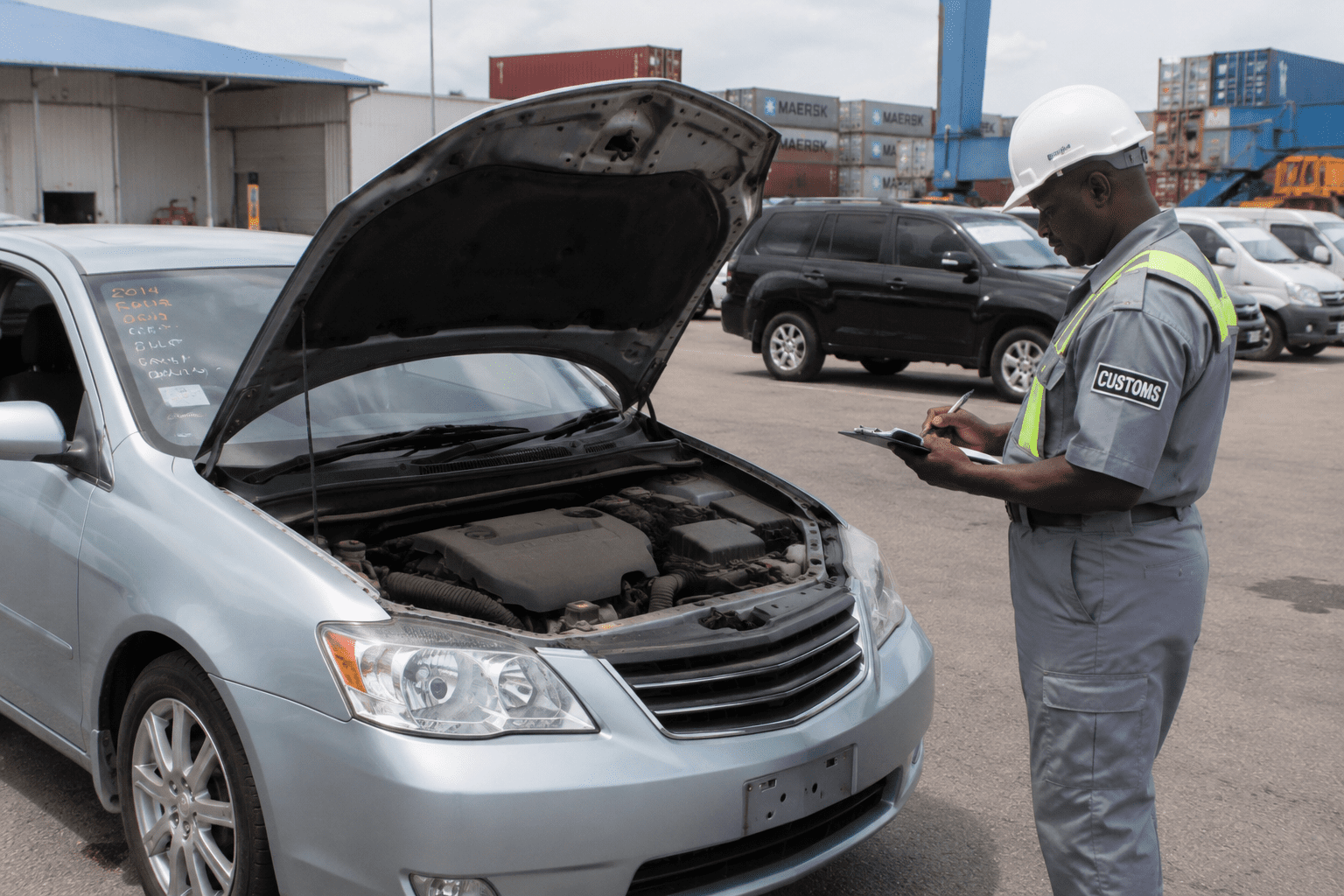
Vehicles Ghana Won’t Accept: Restrictions You Must Know
Not every car can be shipped to Ghana. Before you book anything, make sure your vehicle clears these restrictions:
Vehicles with salvage or flood-damage history face additional scrutiny and may be rejected outright. If you’re sourcing from an auction, always check the title status carefully.
Ghana has introduced emissions standards that non-compliant vehicles may not meet, which can trigger additional environmental levies. Emissions rules can change, so confirm your vehicle’s compliance with GRA or your clearing agent before you commit to a purchase.
Pure electric vehicles (EVs) may qualify for reduced or zero import duty in Ghana, an incentive many importers overlook. If you’re considering an EV, ask our team to confirm the current duty treatment for your specific model before you buy, since incentive schemes are subject to change and the vehicle will still need to meet Ghana’s other import requirements, including left-hand drive.
What Shipping Methods Are Available? RoRo vs Container
How you ship your car from the UK affects the total landed cost and the level of protection your vehicle receives during transit.
RoRo Shipping to Ghana
RoRo shipping is the cheaper, faster option for standard cars, saloons, hatchbacks, SUVs, and vans. Your car is driven directly onto the vessel and off again at Tema Port, with no extra handling in between.
Container Shipping to Ghana
Container shipping to Ghana suits luxury cars, classic vehicles, high-value 4x4s, or shipments where you also want to send personal belongings alongside the vehicle, since your car travels sealed inside a 20ft or 40ft steel container.
Both methods depart from Tilbury, Sheerness, and Teesport, arriving at Tema or Takoradi Port. For a full comparison, current pricing, and transit times, see our car shipping to Ghana page.
Documents You Need to Import a Car Into Ghana
Missing even one document can bring the entire clearance process to a halt. Here’s the complete list of what you need:
- Original Bill of Lading: Issued by the shipping line after the vessel departs
- Commercial Invoice: Showing the agreed purchase price of the vehicle
- Certificate of Title / Vehicle Ownership Document: Proves the car is legally yours
- Import Declaration Form (IDF)
- Customs Classification and Valuation Report (CCVR): Issued by GRA via ICUMS
- Vehicle Identification Number (VIN): Required to check duty in the ICUMS system
- Tax Identification Number (TIN) or Ghana Card
- Proof of Insurance
- Packing List (if applicable)
One tip from our team at Ascope Shipping: get your VIN number before the car even leaves the UK. You can use it to run a duty estimate through the official ICUMS portal or apps like G-Duty, so there are no nasty surprises when the car lands.
Step-by-Step: How Ghana Port Clearance Works
Once your vehicle arrives at Tema Port, here’s what happens:
Step 1. Document Submission: Your clearing agent uploads all documents to the ICUMS portal. This digital system has replaced the old paper-based process and is now fully automated.
Step 2. CCVR Issuance: Customs issues the Classification and Valuation Report, which shows the calculated duties based on your vehicle’s CIF value, engine size, and age.
Step 3. Duty Payment: You pay the assessed duty through the Ghana.gov platform or linked banks. Note that GRA uses a weekly customs exchange rate set by the Bank of Ghana.
Step 4. Physical Inspection and Release: Customs officers carry out a physical inspection at the terminal. Once cleared, you receive a release order and can collect your vehicle.
The golden rule: Act quickly, most ports allow a free storage period of 7–14 days from vessel discharge. After that, demurrage and storage fees kick in. And they add up fast.
Hidden Costs Most Importers Don’t Expect
The duty bill is rarely the final figure. Here’s what often catches people off guard:
Demurrage fees
If your paperwork isn’t ready when the vessel arrives, port storage charges begin immediately after the free period ends.
Clearing agent fees
While you can technically clear a vehicle yourself, it requires registering with GRA as a customs agent. In practice, virtually everyone uses a licensed clearing agent, and their fees vary.
GHS/GBP exchange rate movement
Duties in Ghana are calculated in US dollars but paid in Ghanaian cedis. The cedi can fluctuate, and a rate shift between when you booked the shipping and when you pay duty can add real cost.
Port handling charges
Separate from government duties, these are charged by the Ghana Ports and Harbours Authority (GPHA).
DVLA registration
After customs clearance, you’ll still need to register the vehicle with Ghana’s Driver and Vehicle Licensing Authority before it can be driven on the road.
Advance tip: Always add a 10 to 15% contingency buffer to your landed cost estimate. It’s far better to budget for it and not need it than to be caught short at the port. For more on what catches people out, see our guide on mistakes when shipping a car to Ghana.
How to Reduce Your Ghana Car Import Tax Legally
You can’t avoid Ghana car import duties and taxes, but you can manage them smartly:
Choose a smaller engine
A 1,000cc hatchback attracts 5% base duty versus 20% for a large-engine SUV or pickup over 3,000cc. That’s a substantial saving on the same CIF value.
Keep the car under 10 years old
Staying inside the 10-year window avoids overage penalties entirely — and keeps your total duty burden at the standard rate.
Consider an electric vehicle
Pure EVs currently attract 0% import duty in Ghana, making them one of the most cost-effective options for importers who can source a compliant left-hand drive model.
Get your documents right first time
Delays cost money through demurrage. Having every document ready before the ship arrives is the single most effective way to control post-arrival costs.
Use a trusted UK shipping partner
At Ascope Shipping, we prepare all your UK export paperwork to GRA’s exact requirements, so your clearance agent in Ghana has everything they need the moment the vessel docks.
Real Cost Example: What Does It Actually Cost to Import a Car to Ghana?
Say you’re importing a 2019 Toyota RAV4 with a 2,000cc engine from the UK.
- Vehicle purchase price: £12,000
- UK shipping (RoRo, Tilbury to Tema): £900
- Insurance: £150
- CIF value (depreciated MSRP used by ICUMS): approximately £13,050
Estimated Ghana import charges:
| Charge | Estimated Amount |
|---|---|
| Import Duty (10%, on CIF) | £1,305 |
| NHIL (2.5%, on CIF + Duty) | £359 |
| GETFund (2.5%, on CIF + Duty) | £359 |
| VAT (12.5%, on CIF + Duty + NHIL + GETFund) | £1,884 |
| EXIM + AU + ECOWAS levies (~1.45%, on CIF) | ~£189 |
| Special Import Levy (2%, on CIF) | £261 |
| Examination Fee (1%, on CIF, used vehicles only) | £131 |
| Total estimated duty | £4,488 |
Add clearing agent fees, port handling, and DVLA registration and you’re looking at a total landed cost in the region of £17,200 to £18,200 for a car you paid £12,000 for. That’s why understanding Ghana car import taxes before you buy is so important.
What is the cheapest way to import a car to Ghana?
Choose a newer vehicle (under 10 years old) with a smaller engine (under 1,500cc) to minimise duty rates. Use RoRo shipping from the UK for the most cost-effective freight option. Having all documents ready before arrival also avoids costly demurrage fees.
Are electric vehicles exempt from import duty in Ghana?
Yes. As of 2026, pure electric vehicles (EVs) qualify for 0% import duty in Ghana. This makes EVs one of the most duty-efficient options for importers, though the vehicle must still be left-hand drive and meet Ghana’s other import requirements.
Ship Your Car to Ghana with Ascope Shipping
Ascope Shipping has been helping individuals, families, and businesses ship vehicles from the UK to Ghana for over 15 years. We handle everything from the UK side of the process, including export paperwork, RoRo or container booking, and port departure. Work with trusted Ghana-based agents to keep your clearance moving smoothly.
We ship from Tilbury, Sheerness, and Southampton to Tema and Takoradi, with transparent pricing, no hidden charges, and real people you can actually talk to. For a complete walkthrough of the entire process, check out our full car shipping guide to Ghana. Request a free quote today and our team will walk you through the best shipping option for your vehicle and budget.