
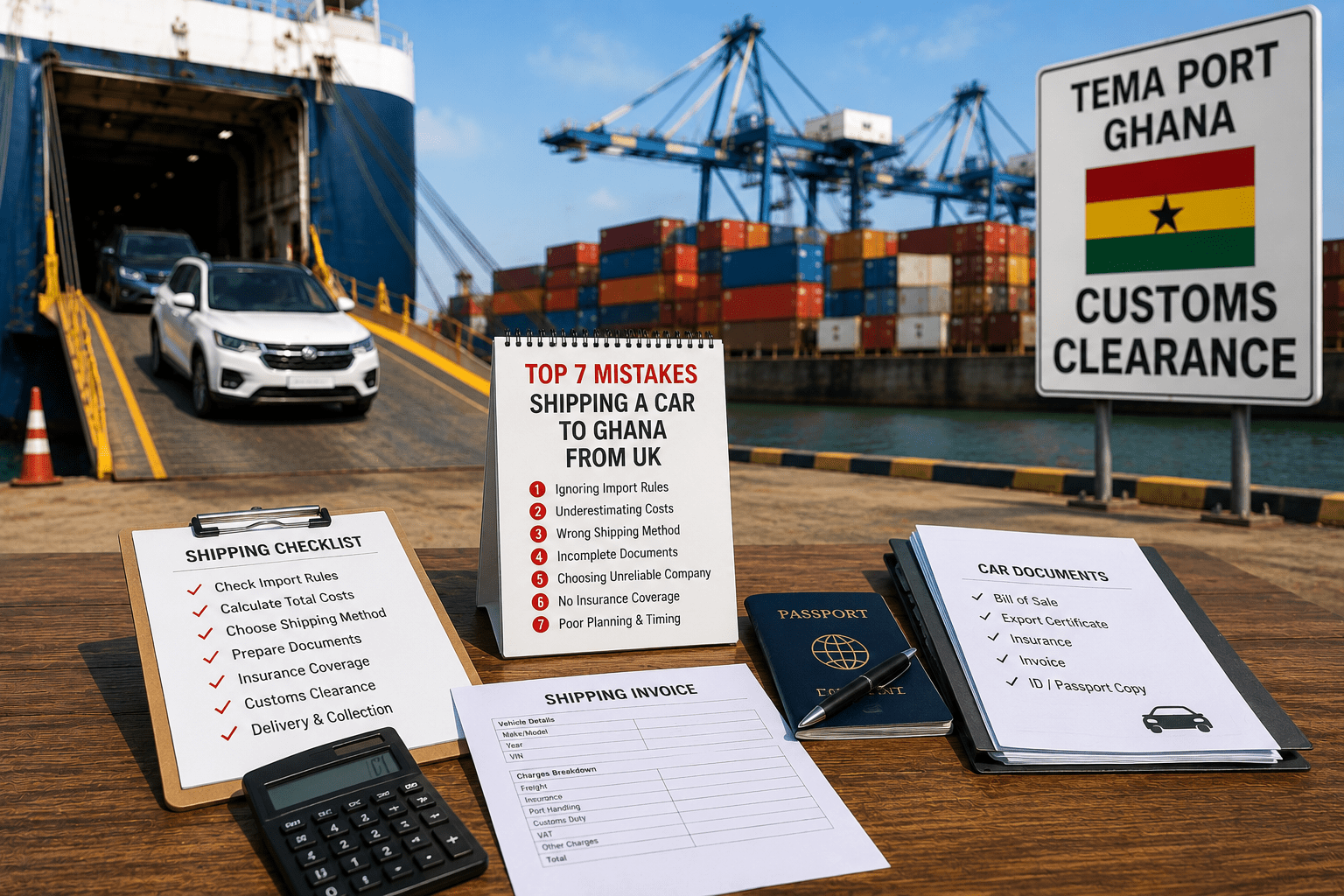
Shipping a car to Ghana from the UK sounds simple – until it isn’t. Every year, hundreds of people lose money, face delays, or have their vehicles held at Tema Port because of entirely avoidable mistakes. Some are caught by Ghana’s import rules. Others are blindsided by costs they never budgeted for. And many trusted the wrong company to manage one of their most valuable assets.
As a leading UK vehicle shipping company, Ascope Shipping, we’ve been helping people with vehicle shipping from the UK to Ghana for over 15 years. We’ve seen firsthand what goes wrong and, more importantly, what you can do to make sure it doesn’t happen to you.
Whether you’re sending a car back home to family in Accra, relocating permanently, or shipping a used car for resale.
7 Mistakes When Shipping a Car to Ghana from the UK
Mistake 1: Not Understanding Ghana’s Import Rules Before You Ship
This is the most expensive mistake of all and the most common. Ghana has specific and non-negotiable rules for importing vehicles, and if your car doesn’t meet them before it leaves the UK, you could face heavy fines, forced modifications, or complete refusal at the port.
The 10-year age rule is the one that catches most people off guard. Ghana’s Ghana Revenue Authority (GRA) enforces a strict maximum age limit of 10 years on imported used vehicles, calculated from the year of manufacture, not the registration date. For vehicles arriving in 2026, that means your car must be a 2016 model or newer to qualify for standard import without penalty. Older vehicles face a tiered penalty system on top of standard duties, ranging from roughly 5% extra for cars 10–12 years old, all the way up to 50% or more for vehicles over 15 years old. That can add thousands to your bill.
The right-hand drive restriction is another rule that trips up UK exporters specifically. Ghana drives on the right, and under Ghanaian customs law, right-hand drive vehicles are technically restricted. There is a policy dispensation that allows some right-hand drive vehicles in on application, but this requires the Minister of Trade’s approval, and once cleared at the port, your vehicle must be dismantled and refitted with left-hand drive steering before it can be used on Ghanaian roads. That conversion is costly and time-consuming. If you’re shipping a used car from the UK to Ghana for personal use or resale, this is something you must factor in before purchase.
Beyond age and steering, Ghana’s customs process now runs through ICUMS, the Integrated Customs Management System, which handles all import declarations digitally. If your declared CIF value (Cost, Insurance, Freight) falls outside what the system considers reasonable for your vehicle type and year, it gets flagged automatically. That leads to valuation disputes, delays, and additional fees.
The fix: Before you book anything, confirm your vehicle’s model year, steering configuration, and estimated duty costs. Speak to a specialist freight forwarding company like Ascope Shipping, who can advise you on Ghana’s customs rules for cars before a single thing is booked.
Mistake 2: Ignoring the True Total Cost of Shipping
People often look at the basic UK to Ghana car shipping price and assume that’s the full cost. It rarely is. The freight charge is just the starting point and if you don’t account for everything else, you can end up paying significantly more than expected once your car arrives at Tema port.
Here’s what the total UK to Ghana car import cost typically includes:
- Shipping freight: The base cost (RoRo from around £775 for a saloon; container from £1,240 for a 20ft)
- UK port handling and documentation fees
- Marine cargo insurance: Essential and too often skipped
- Ghana import duty: Calculated on CIF value under the ECOWAS Common External Tariff (CET), typically 5–20% depending on engine size
- VAT: Currently 15% under Ghana’s ICUMS system (effective from 2026 reforms)
- NHIL and GETFund levies: Combined approximately 5%
- Age-based overage penalties: If your vehicle is over 10 years old
- Port storage and handling charges at Tema
- Demurrage fees: Charged per day if your car sits uncollected beyond the free storage period
- Clearing agent fees in Ghana
- Local transport from Tema to final destination
The CIF value calculation is particularly important to understand. Ghana customs calculates duty based on the original manufacturer’s suggested retail price, depreciated over the vehicle’s age, plus the cost of shipping and insurance. This is not the price you paid for the car. If you underestimate your CIF value to try to reduce duty, ICUMS will flag it immediately and the consequences are far worse than paying the correct duty upfront.
The fix: Request a fully itemised quote that covers every element of the journey, from UK collection to Tema Port clearance. At Ascope Shipping, we provide transparent quotes with no hidden costs, so you know exactly what you’re paying before your vehicle moves an inch.
Mistake 3: Choosing the Wrong Shipping Method
Not every car should be shipped the same way. Choosing between RoRo shipping to Ghana and container shipping to Ghana comes down to your vehicle type, its value, and what you need to include in the shipment.
RoRo (Roll-on/Roll-off) is the cheapest way to ship a car to Ghana from the UK and the most popular method. Your vehicle is driven directly onto the vessel at the UK port, secured with straps and chocks, and driven off on arrival in Ghana. It’s cost-effective and has frequent sailings from Tilbury and Sheerness. Transit time is typically 14–28 days. The one limitation: your car must be drivable, and you cannot load personal belongings inside it.
Container shipping to Ghana offers far greater protection and flexibility. Your vehicle is loaded inside a sealed 20ft or 40ft steel container, completely shielded from weather, handling, and other cargo. This is the right choice for luxury cars, classic or high-value vehicles, non-runners, or any situation where you also need to ship personal effects alongside the car. A 20ft container fits one vehicle comfortably; a 40ft container can take two cars plus additional items.
The mistake people make is choosing purely on price without considering risk. Sending a £15,000 Range Rover via RoRo to save a few hundred pounds is a false economy if it arrives with damage that wouldn’t have occurred in a container. Equally, spending on a container for a basic saloon when RoRo is perfectly suitable wastes money you could use elsewhere.
The fix: Talk to a specialist. At Ascope Shipping, our team assesses your vehicle and your needs to recommend the right method, not the most expensive one, but the most appropriate one.
Mistake 4: Missing or Getting Documents Wrong
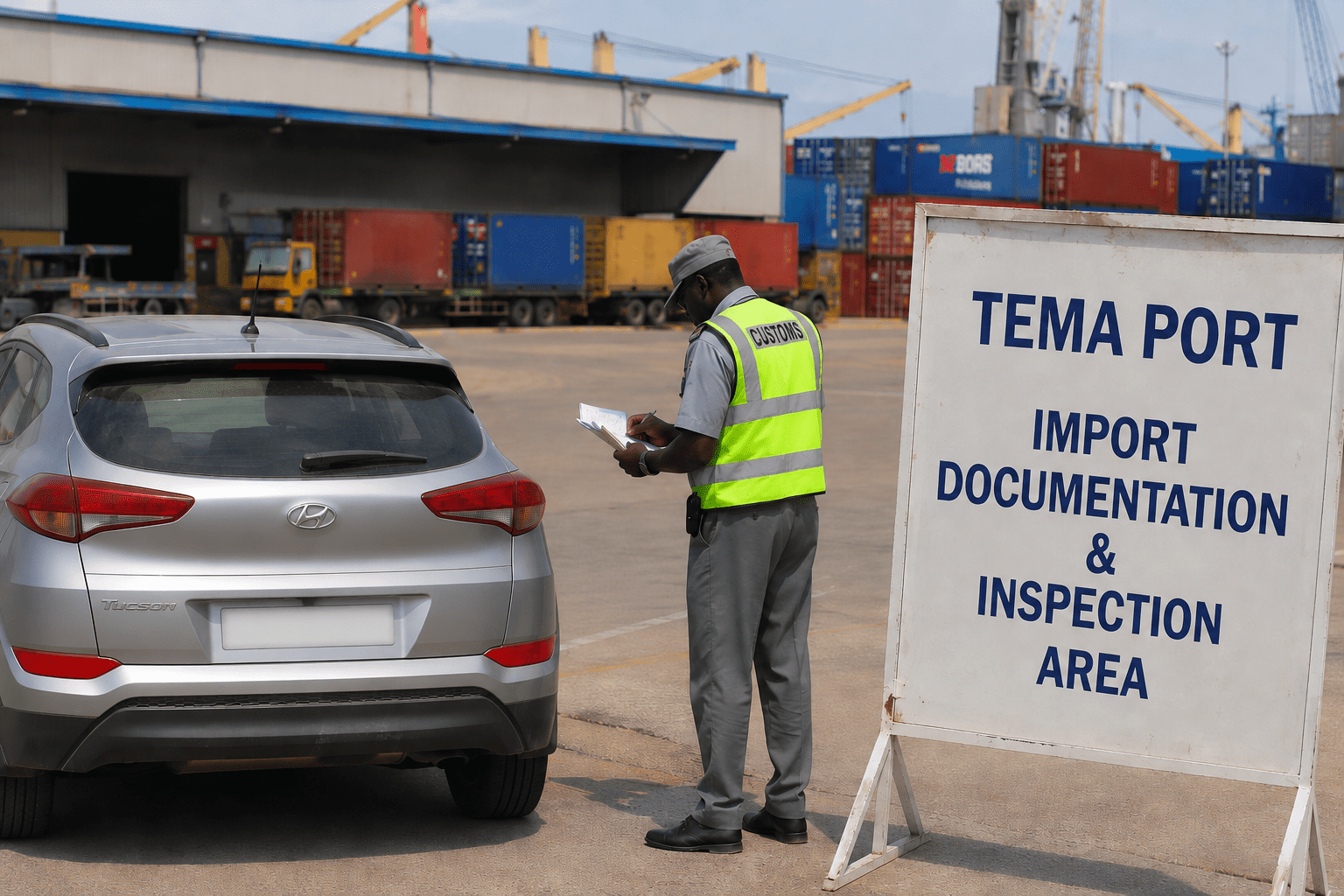
Incomplete or incorrect paperwork is one of the leading causes of cars being held at Tema Port. Ghana customs operates on tight documentation requirements, and under ICUMS, everything is submitted electronically. There is no room for gaps or errors.
The documents you need to ship a car from the UK to Ghana include:
- Original V5C logbook: Proof of UK ownership and registration
- Original purchase invoice: Showing what you paid for the vehicle
- Valid Bill of Lading: Issued by the shipping company, listing chassis number, engine number, manufacturing date, and vehicle type
- Import Declaration Form (IDF)
- Copy of passport or national ID
- Ghana Customs Form C (completed at destination)
- Proof of insurance
One document that’s commonly mishandled is the Home Delivery Value (HDV), which Ghana customs uses as part of the CIF calculation. If the values don’t align across your invoice, Bill of Lading, and HDV declaration, it triggers a customs query that can hold your vehicle for weeks.
If your vehicle is left uncollected at the port for longer than 60 days, Ghana customs is entitled to seize it. That’s not a threat, it happens regularly to people who didn’t have their paperwork in order and couldn’t complete clearance in time.
The fix: Start gathering documents well before your shipping date. Use a reliable shipping company that handles export documentation on your behalf and has direct relationships with trusted clearing agents in Ghana. Ascope Shipping manages UK export documentation for every shipment we handle.
Mistake 5: Not Preparing Your Vehicle Properly Before Shipping
A car that arrives at the UK port unprepared can be refused for loading, causing delays, missed vessel slots, and extra charges. And a vehicle that arrives in Ghana in poor condition, without proper records of its pre-ship state, gives you very little recourse if something goes wrong.
Here’s how to prepare your car for shipping overseas properly:
- Clean the interior and exterior thoroughly. Port inspection staff need to assess the vehicle, and a dirty car raises unnecessary flags. This also matters for phytosanitary checks at the Ghanaian port.
- Remove all personal belongings unless you’re using a container service and have declared them on your documentation. For RoRo shipments, nothing should be inside the vehicle.
- Leave approximately a quarter tank of fuel, enough to drive on and off the vessel, but not so much that it becomes a hazard.
- Disconnect or arrange to have the battery accessible. UK port rules require that batteries be disconnected before loading, and on certain vehicles, like some Mercedes models, where the battery is in the boot, nothing can be placed over it.
- Check tyre pressures, fluid levels and that the vehicle is drivable, essential for RoRo. If your car can’t be driven, it must go by container and will require forklift loading, which costs more.
- Photograph every panel, inside and out. This is your evidence record if any damage occurs during transit.
- Take out marine cargo insurance. This is not optional if you care about protecting the value of your vehicle. Standard carrier liability is limited, and Ascope Shipping strongly recommends arranging adequate marine insurance for every shipment.
Hazardous items, food, fridges, mobile phones, and solar panels are not permitted inside vehicles being shipped to Ghana. These restrictions are enforced at the UK port and will cause delays or refusal if found.
The fix: Follow the pre-shipping checklist above and confirm requirements directly with your shipping company before drop-off.
Mistake 6: Underestimating How Long Shipping Takes
People regularly underestimate the timeline for shipping a car from the UK to Ghana. They book the sailing and assume the car will be drivable in Ghana within a couple of weeks. The reality is more nuanced and planning around unrealistic timelines causes real stress and financial pressure.
Here’s a realistic timeline breakdown:
- UK export documentation and port preparation: 3–5 working days
- Vessel sailing frequency: RoRo services depart from Tilbury and Sheerness, typically weekly or fortnightly. If you miss the vessel closing date, you wait for the next one
- Transit time at sea: 14 to 28 days depending on vessel, route, and port of call
- Tema Port customs clearance: Can be 5 to 14 working days, sometimes longer if documentation is incomplete or if there’s a port dispute (in April 2026, Ghanaian trader groups raised concerns about ICUMS’s automated valuation system, leading to delays at ports)
- Local transport from Tema to your location in Ghana: 1 to 3 days
In total, you should realistically plan for 6 to 10 weeks from the day your vehicle leaves you in the UK to the day it’s in someone’s hands in Ghana. If your recipient in Ghana needs the car for something time-sensitive, build a buffer into that plan.
Delays at Tema Port often stem from incomplete documentation or valuation disputes, both of which are largely preventable. Every day your vehicle sits in the port beyond the free storage period, demurrage charges accumulate. These can escalate quickly and are entirely avoidable with proper planning.
The fix: Book your shipment well in advance. Use Ascope Shipping’s shipping schedule to plan around vessel closing dates and ensure your documents are ready before the deadline.
Mistake 7: Not Using a Reliable, Experienced Shipping Company
This is where everything else either comes together or falls apart. The shipping company you choose determines the quality of your documentation, the accuracy of your customs advice, the handling of your vehicle, and your peace of mind throughout the entire process.
Too many people choose a company based solely on price and discover too late that cheap shipping often means unreliable communication, poor documentation, and no real accountability when something goes wrong. In the world of international car shipping, experience and reputation genuinely matter.
What to look for in a reliable shipping company for UK to Ghana:
- Verifiable experience in UK to Ghana car shipping specifically, not just general freight
- Transparent, itemised pricing with no hidden fees
- Knowledge of Ghana’s customs rules, ICUMS procedures, and GRA requirements
- Access to trusted clearing agents at Tema and Takoradi ports
- Proper documentation handling, including UK export compliance
- Positive customer reviews on independent platforms like Trustpilot
- Clear communication at every stage of the shipment
Ascope Shipping is a Hull-based international car shipping specialist with over 15 years of dedicated experience in vehicle shipping from the UK. We handle everything from RoRo car shipping and container shipping to customs and excise guidance and collection from anywhere in the UK. Our vessels depart from Tilbury, Sheerness, and Teesport, with regular sailings to Tema and Takoradi. We work with proven clearing agents in Ghana, so your vehicle clears customs as smoothly as possible.
We don’t just move cars, we guide you through the entire process, answer your questions, and make sure your vehicle arrives safely, on time, and without nasty surprises.
The Complete UK to Ghana Car Shipping Checklist
Before you book your shipment, run through this checklist to make sure you’re fully prepared:
- The vehicle is 10 years old or newer (model year 2016 or later for 2026 imports)
- Steering configuration confirmed (right-hand drive restrictions understood)
- Full itemised cost breakdown obtained, including duty, VAT, port charges, and clearance
- Shipping method chosen (RoRo or container) based on vehicle value and needs
- All documents ready: V5C, purchase invoice, passport copy, Bill of Lading
- Vehicle cleaned, photographed, and mechanically prepared
- Battery accessible and vehicle drivable (for RoRo)
- Marine cargo insurance arranged
- Realistic timeline planned (6–10 weeks end-to-end)
- Trusted shipping company booked with Ghana-specific experience
Ready to Ship Your Car to Ghana from the UK?
Avoiding these seven mistakes is the difference between a smooth, stress-free shipment and a costly, drawn-out nightmare. The good news is that every single one of them is entirely preventable with the right preparation and the right partner.
At Ascope Shipping, we’ve spent 15 years making car shipping to Ghana from the UK as easy as possible. Whether you’re in London, Manchester, Birmingham, or anywhere else in the UK, we’ll collect your vehicle, handle all the paperwork, and get it safely to Tema or Takoradi.
Get your instant car shipping quote today or call us on 01482 228366 to speak with our team directly. No obligation, no hidden costs, just expert advice from people who know this route inside out.